


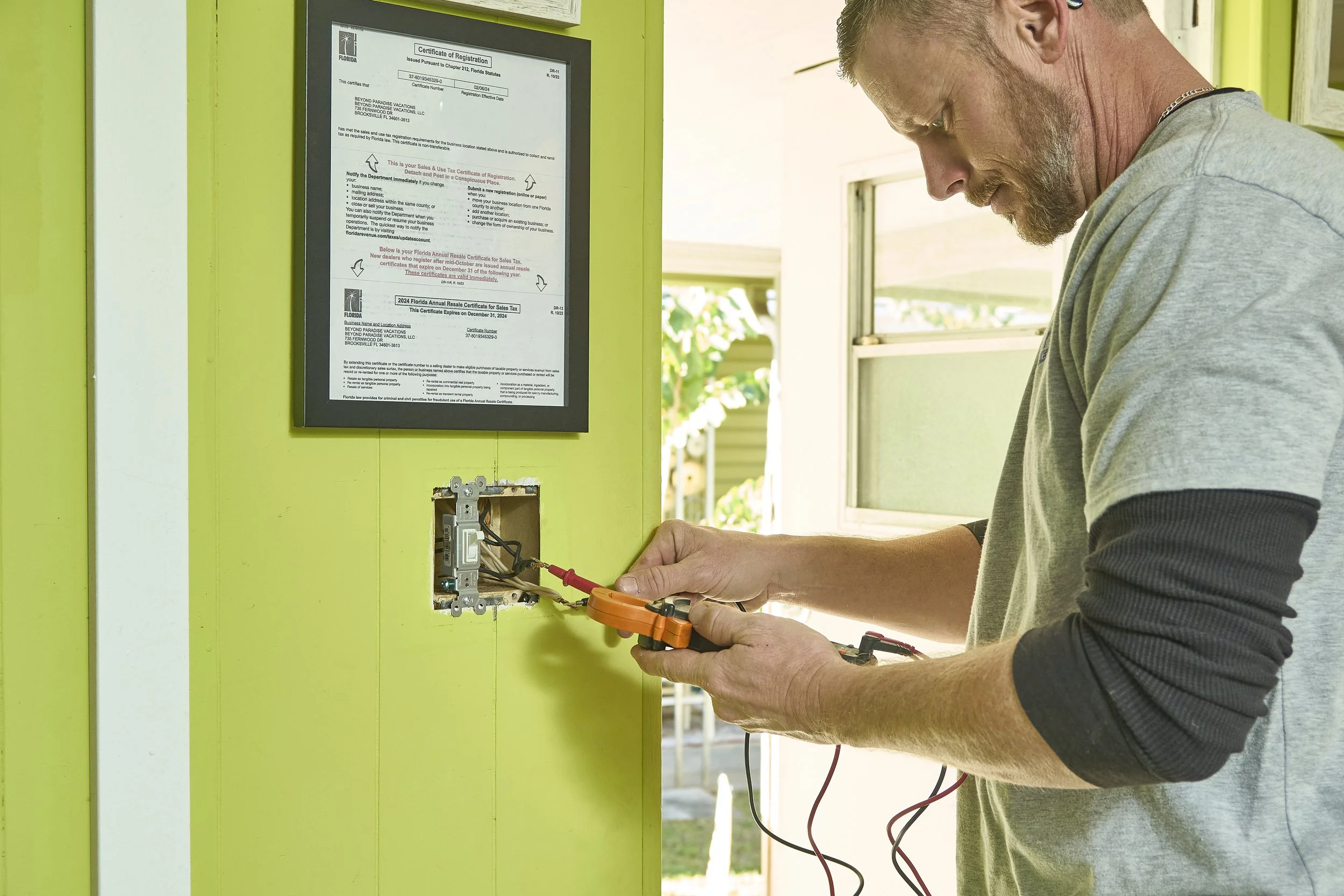
Dimmer and Smart Switch Installation in Spring Hill, FL
Fitted to Every Switch That Runs the Light|Licensed & Insured, EC13011268
Turn one of two hallway switches into a dimmer, and the switch at the far end of the hall has a say in whether it works. In a Spring Hill house, the first thing to settle for any light is how many switches control it, because that number narrows the dimmers and smart switches that will run it properly. We install both, on the wires a box already holds or with the cable it needs.
Note each light you'd dim and how many switches run it.
Call (352) 251-2795, Monday through Friday, 8 a.m. to 4 p.m., or send a request online. Calls after hours are returned the next business day.
At a glance
Spring Hill Houses and the Switch Boxes Behind the Plates
In Spring Hill, 24,668 homes date from 1980 through 1999 by census estimate, and 15,952 of those from the 1980s alone. Wiring from those two decades predates the National Electrical Code's call for a neutral wire at most switch locations, so a switch box there may carry only the pair of wires a plain switch uses. A standard dimmer runs on those two. Many smart switches can't, and they need either a neutral brought to the box or a model built to run without one. Newer houses tend to be the other case: the 906 Spring Hill homes built in 2020 or later went up after that neutral rule was in force, so a smart switch is more likely to fit the wires already in their boxes.
For a house outside a flood zone, a dimmer wired to the conductors already in its box is on Hernando County's list of permit-free swaps. A neutral run to an older box is new cable, though, and new cable needs a county permit.
How it runs
Your Switch Count, Done Ahead of the Visit
-
1
Pick the lights you'd like dimmed
Start with the lights you'd use at a lower setting, such as the one over a dining table or in a family room, rather than every switch in the house. A short list keeps the visit on the rooms that matter to you.
-
2
Count the switches on each one
Turn the light on at one switch, then try to turn it off at another. If a second switch works it, the light has a partner, and both boxes are part of the job. A light with a third switch has two partners.
-
3
Note any switch that acts up
A switch that works in some positions and not others, or a light that flickers when its switch is touched, can point to a loose connection in a box. Mention it with your request, because a box like that needs repair before a dimmer goes in.
What we cover
Fitting a Dimmer to the Number of Switches on a Light
Every light in a house is run from some number of wall switches, from one to three or more. Each count calls for its own kind of control.
One switch on the light: a single-pole dimmer swap
When a light answers to one switch alone, the work stays in that box. The old switch comes out, and a dimmer or smart switch connects to the same wires. With no second box to match, a smart switch here needs no companion control.
Two switches on one light: dimming a three-way pair
A light with a switch at each end of a hall, or at both doors of a family room, runs on a three-way pair joined by extra wires between the two boxes. A plain three-way dimmer can take one end while the other keeps its toggle, so the light dims from one spot and turns on and off from both. For dimming or smart control at both ends, the pair changes together: a dimmer at one end and a companion from the same maker at the other. An old toggle left opposite a smart dimmer usually won't work with it unless the maker allows it.
Three or more switches: four-way runs and smart dimmers
Some lights answer to three switches or more, as in a long hall with a door partway along or a room with three entries. The switches between the two ends of that run are four-way switches, a different type from the ones at either end. A smart setup gives every spot a companion, and its instructions say which box takes the main dimmer, often the one where power arrives or the one where the cable leaves for the light. Finding those two boxes comes before a model is chosen.
A new place to switch the light from
A light with one switch can gain a second, at another door of the same room. One way is a second switch box, fed by new cable from the first. Some smart dimmers offer another way: a battery-powered remote from the same maker that mounts on the wall like a switch, with no wires behind it. Pairing that remote follows the maker's steps and is the owner's to do.
Pricing
Switch Spots and the Dimmer Estimate
Keeping a light's existing switch spots or adding a new one changes the price, since a new spot brings a new box and cable with it.
Custom homes and large or multi-phase projects are estimated as soon as we can, or on the timeline your project sets.
Repair and troubleshooting visits are billed by the hour from arrival: $100 residential, $150 commercial, one-hour minimum, then half-hour increments, plus materials. No trip charge and no service fee. No hidden fees: the 3.5% surcharge on card and ACH payments is listed in our terms.
We don't do upfront pricing. No job has a standard price with us: each one is tailored to the property and the work you've asked for, and priced once we've seen it.
We offer free estimates on installs, upgrades, and replacements in our service area. Estimates aren't free when the job needs troubleshooting or testing to price, falls after hours or outside our service area, needs several meetings to gather information, or is new construction or a custom remodel with multi-party walk-throughs. For most jobs, estimates arrive by email by the end of the next business day, and quotes are good for 30 days.
Our warranty
05If something we installed fails because of our workmanship within 30 days of completion, we waive the hourly labor to put it right. Materials Kennedy Electric purchases for your job carry the manufacturer's one-year warranty. To replace defective materials we supplied, or materials damaged by storm, flood, fire, or other acts of God, we charge a reduced warranty labor rate of $50 an hour residential and $75 an hour commercial. The warranty does not cover materials not purchased by Kennedy Electric, work performed by the customer, or materials the customer purchased or damaged. Our warranty terms are printed on the estimate, the invoice, and the receipt, and the product boxes stay with you so you can register each product with its manufacturer.
Rooms were added onto our Spring Hill house after it was built. Can the switch boxes differ from room to room?
One bulb on the dining room dimmer in our Spring Hill house looks darker than the rest. Is the dimmer at fault?
The kitchen in our Spring Hill house still has its fluorescent ceiling panel. Can it go on a dimmer?
Does a dimmer cut how much power the lights use?
We use smart bulbs in a few fixtures. Can those fixtures go on a dimmer too?
Reviews
Switch Jobs Worth Reading About
Straight from Google, in our customers' own words.
Request service
Lower the Lights in Your Spring Hill Rooms
Say which lights you'd like dimmed, with the switch count you found on each. Our office will reach you during business hours.