


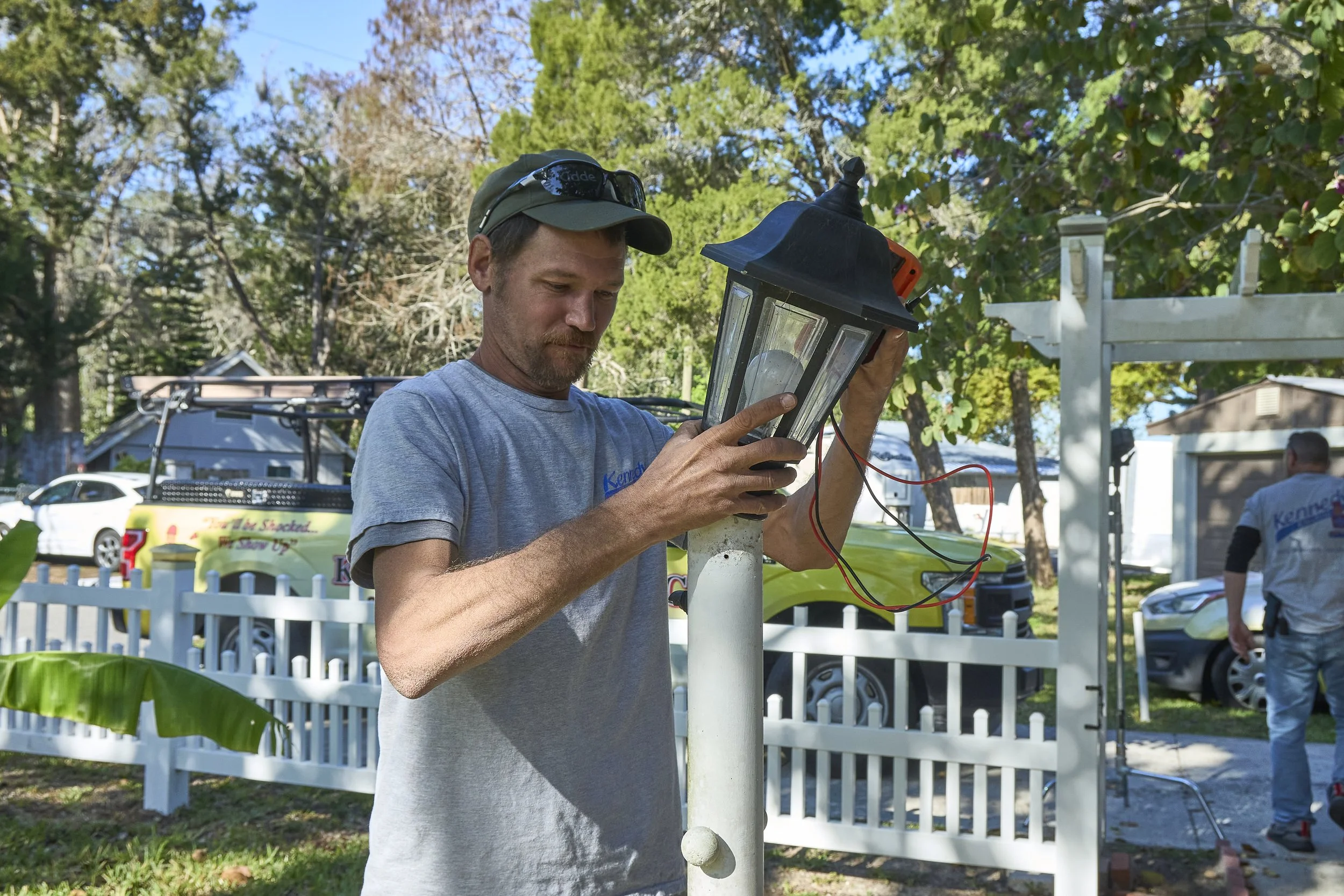
Outdoor Lighting in Land O' Lakes, FL
Uplights, Shielded Fixtures, and the Power Behind Them|Licensed & Insured, EC13011268
Connerton's homeowner rules recommend uplighting on the front of a house, ask that spotlights be concealed from direct view and kept from spilling onto the next lot, and call for shielding on every outdoor fixture mounted on a home. Those three lines shape which fixtures we put up, where they sit, and which way they point.
Tell us which community the house is in and what you want lit after dark.
Call (352) 251-2795, Monday through Friday, 8 a.m. to 4 p.m., or send a request online. Calls after hours are returned the next business day.
What we cover
What Connerton's Homeowner Rules Ask of Outdoor Lights
Connerton is a planned community off US 41, with a Land O' Lakes mailing address. Its Homeowner Regulations, Restrictions and Standards cover outdoor lighting in a landscape lighting section and a lighting section, and changes to a residence there go to Connerton's Architectural Review Committee for review. Each lighting rule changes something about the job.
Uplighting on the front of the house
Uplighting is recommended, and it may wash the front face of the house or significant landscape features. The light is meant to feel warm and inviting, and it shouldn't distract, annoy, or look unsightly.
For a front wall, that points to low fixtures set in the bed along the house, spaced between the windows and tipped toward the wall, so the face of the house glows evenly and the beams stay off the glass.
Spotlights hidden from direct view
A spotlight is to be concealed from direct view and aimed so its light doesn't spill onto the adjacent property. So it goes behind a shrub, a border, or the tree it lights, and it gets a glare shield. On a lot where a tree sits close to the property line, the beam is angled in toward the house and up into the canopy. A palm lit by a single fixture tends to show a bright stripe up one side of the trunk; a second fixture on the opposite side, or one set back from the base, lights it more evenly.
Shielding on fixtures mounted on the house
No exterior fixture may go on a home without adequate and proper shielding, and none may become an annoyance or a nuisance to the home next door. Coach lights by the garage, a light over the front door, and a motion flood at the side of the house each get a housing that keeps the lamp out of direct view.
House numbers you can read at night
Each house is to show its number on the front facade, clearly visible from any direction of approach, in a form the Architectural Review Committee has approved. After dark, that number is part of the lighting plan: either the wall wash is placed so it falls across the numbers, or a small shielded fixture is aimed at them. Either way, the aim is an address that stays readable from the street at night.
What we cover
Lamp Color, Separate Runs, and Power for the Transformer
Warm lamps and the right beam
A warm, inviting look comes down to two choices made for each fixture. The first is color: warm-white LED lamps in the 2700K to 3000K range read as lamplight against a painted wall, whereas a cooler white reads as a parking lot. The second is the beam: a wide flood for washing a wall, and a narrow spot for reaching up a palm trunk or into a tall canopy. Lower-output lamps maintain an even wall wash, without bright patches near each fixture.
Wall wash and garden on separate controls
A front wall washed in light and a spotlit tree don't always need to come on together. With the uplights on one run and the spotlights on another, fed from a multi-zone transformer or from two transformers, each run can keep its own schedule: a photocell can bring both on at dusk, and a timer can turn off the run nearest the next lot at bedtime while the wall wash stays on later. A low-voltage system plugs into a GFCI-protected outdoor receptacle near the transformer. If there isn't one in the right place, we add one to a circuit that suits the load, with an in-use cover to keep it weatherproof when the cord is plugged in.
Pricing
An Estimate Drawn From the Lighting Plan
We don't do upfront pricing. No job has a standard price with us: each one is tailored to the property and the work you've asked for, and priced once we've seen it.
We offer free estimates on installs, upgrades, and replacements in our service area. Estimates aren't free when the job needs troubleshooting or testing to price, falls after hours or outside our service area, needs several meetings to gather information, or is new construction or a custom remodel with multi-party walk-throughs. For most jobs, estimates arrive by email by the end of the next business day, and quotes are good for 30 days.
Our warranty
02If something we installed fails because of our workmanship within 30 days of completion, we waive the hourly labor to put it right. Materials Kennedy Electric purchases for your job carry the manufacturer's one-year warranty. To replace defective materials we supplied, or materials damaged by storm, flood, fire, or other acts of God, we charge a reduced warranty labor rate of $50 an hour residential and $75 an hour commercial. The warranty does not cover materials not purchased by Kennedy Electric, work performed by the customer, or materials the customer purchased or damaged. Our warranty terms are printed on the estimate, the invoice, and the receipt, and the product boxes stay with you so you can register each product with its manufacturer.

Does Connerton require uplighting on our house?
Can we light the oak in the front yard?
When can the holiday lights go up, and what do we plug them into?
Can we put up permanent roofline lights in Connerton?
We're repainting the house. Should new lights go up before or after?
Reviews
Kennedy Electric's Record With Customers
Straight from Google, in our customers' own words.
Request service
Tell Us What Should Glow and What Should Stay Dark
Send the address, the community, and the parts of the house or yard you want lit. Our office will reach you during business hours.