


Why Do My Lights Flicker? The Pattern That Says Call an Electrician
A flickering light is one of those household annoyances that sits in a strange gray zone. Sometimes it means nothing more than a bulb that worked itself loose in the socket. Sometimes it is the first visible sign of a wiring fault that can arc, overheat, and start a fire inside a wall where you cannot see it. The frustrating part is that both look identical for the first half-second. What separates the harmless flicker from the serious one is not the flash itself but the pattern around it: which lights, how often, and what else is happening at the same time.
This guide walks through the causes in order, from the cheapest and safest to the most urgent, so you can read your own flicker and know whether you are looking at a five-minute fix or a reason to pick up the phone.
Quick Answer: Most flickering traces to a loose or incompatible bulb and are harmless. A flicker that spreads across multiple rooms or the whole house, or that comes with a burning smell, buzzing, or warm outlets, points to a loose connection or loose neutral and needs a licensed electrician right away. Anything at the panel or in the wiring is not a homeowner's repair.
Start With the Bulb
The single most common cause of a flickering light is also the least alarming: the bulb itself. Over time, especially in fixtures that heat up and cool down repeatedly, a screw-base bulb can back out slightly from its socket. That breaks the steady contact between the base and the little tab at the bottom of the socket, and the light stutters as the connection is made and lost. A gentle snug of the bulb, with the power off and the bulb cool, often ends it.
The second bulb-level cause is newer, and it catches a lot of people who have recently switched to LED. A dimmable LED bulb paired with a dimmer switch built for old incandescent bulbs frequently strobes, shimmers, or buzzes at certain dial positions. The dimmer is chopping the power in a way the LED's internal driver was never designed to handle. An LED that is not rated for the fixture it sits in, such as an enclosed globe or a recessed can, can also behave erratically as it overheats. Swapping in a bulb that is rated for both the fixture and the dimmer usually clears these up, and it costs almost nothing to test.
Loose Fixtures and Loose Connections
If the bulb is snug and correct and the flicker continues, the next place to look is the connection points around it. A light fixture is wired to the circuit at its mounting box, and the wire nuts or terminals there can loosen over the years due to thermal expansion. A ceiling fan with a light kit that vibrates every time it runs is a classic offender. This kind of flicker usually stays confined to that one fixture, and while it is not as urgent as a panel-level fault, it still involves the wiring behind the fixture and belongs to an electrician rather than a screwdriver and a hopeful guess.
When a Big Appliance Kicks On
Here is a flicker that is often completely normal. A large motor, like an air-conditioning compressor, a well pump, or an electric dryer, draws a large current the instant it starts up. Electricians call that surge inrush current, and it can be several times the motor's normal running draw for a fraction of a second. If your lights share a circuit with that appliance, or if the electrical service feeding the house is already running close to its limit, the voltage sags for that brief moment and the lights dip.
An occasional, mild dim right as the AC or the pump cycles on is expected behavior and nothing to worry about. What is worth attention is a hard, deep dim, or one that happens every single time, or one that has clearly gotten worse over the past few months. That progression can mean a connection is deteriorating somewhere between the appliance and the panel, and the circuit is no longer handling the start-up cleanly.
An Overloaded Circuit
Related to the appliance dip is the steadily overloaded circuit. If a single circuit is asked to feed more than it was sized for, a space heater plus a microwave plus a hair dryer on the same run, for example, lights on that circuit can flicker or dim as the load fluctuates. The fix is not to keep resetting a breaker but to redistribute the load or add capacity, which is a planning and wiring question for a licensed electrician who can see the whole panel and how the circuits are laid out.
The Dangerous One: A Loose Neutral
Now, the flicker that should get your full attention. Every circuit has a hot wire that carries current and a neutral wire that carries it back, keeping the whole system balanced. Think of the neutral as the return lane on a two-lane road: when it is clear, traffic flows evenly in both directions. When that neutral connection loosens, at an outlet, at the breaker, or at the panel's neutral bar, the balance breaks down. Voltage starts swinging. Some lights surge unnaturally bright while others in the house dim, and the pattern shifts erratically as loads change around the home.
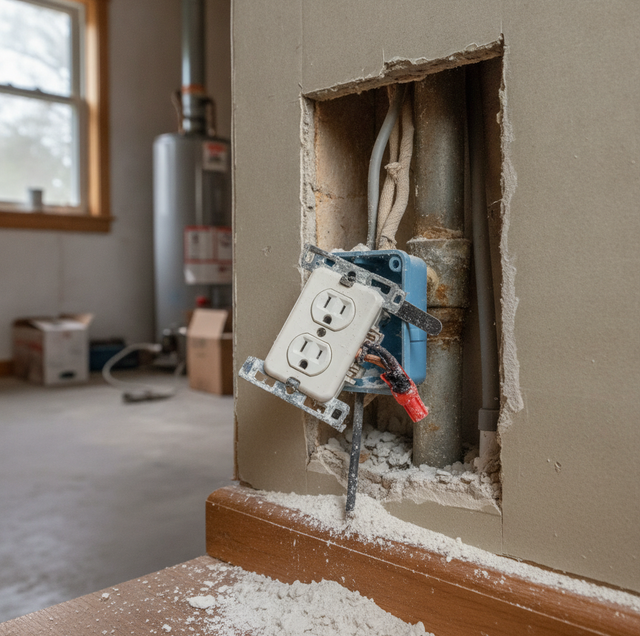
A loose neutral, or any loose connection at a device or in the panel, is the failure mode that turns a flicker into a fire risk. A loose connection does not just interrupt the flow; it creates resistance, and resistance at a bad connection generates heat. That heat can char insulation, discolor the face of an outlet, and eventually arc. This is the cause behind whole-house and multi-room flickering, and it is the reason the wiring and panel side of this problem is never a homeowner's job. Opening a panel or working on energized wiring to chase a loose neutral is dangerous, even for people who do it for a living with the right tools; it is not a place to experiment.
A Problem at the Service or Meter
Sometimes the fault sits upstream of everything inside your walls. A failing utility service drop, a corroded or loose connection at the meter, or a deteriorating weatherhead where the overhead service line enters the house can all cause flickering that affects the whole property. A homeowner cannot diagnose this safely, and part of the job is often the utility's responsibility rather than yours. A licensed electrician can determine whether the trouble is on your side of the meter or the utility's and coordinate the right fix, which sometimes means calling the power company out.
A Loose or Failing Breaker
Finally, the breaker itself can be the culprit. A breaker that has loosened on the panel bus, or one that is simply worn out and failing internally, can cause the lights on its circuit to flicker. Breakers are wear items; they do not last forever, and a tired one can lose its firm grip on the circuit. Diagnosing and replacing a breaker means working inside a live panel, so this, too, sits squarely on the electrician's side of the line.
Signs You Should Call a Pro Right Now
Some flicker patterns are not a wait-and-see situation. Stop and call a licensed electrician promptly if you notice any of these:
- Flickering across several rooms or the entire house at once
- Flicker paired with a burning or hot-plastic smell anywhere in the home
- Outlets, switches, or the panel that feel warm to the touch or look discolored or scorched
- A persistent buzzing or sizzling sound from a fixture, switch, outlet, or the panel
- Lights that brighten and dim erratically on their own, which can point to a loose neutral
Any one of these is a reason to act, not to monitor. A burning smell in particular means you should not wait.
What You Can Safely Check Yourself
There is a short list of homeowner-safe steps, and it stays entirely outside the panel and off any live wiring:
- With the light off and the bulb cool, gently snug the bulb in its socket.
- Try a fresh bulb that is rated for the fixture, and if there is a dimmer, one that is rated as dimmer-compatible.
- Note whether the flicker is limited to one bulb or one fixture, or whether it shows up in several rooms.
That last observation is the most useful thing you can hand an electrician. One bulb or one fixture flickering points toward a minor, local cause. Flickering that spreads across multiple rooms or the whole house points toward the service, the panel, or a loose neutral, which is the serious category. Beyond these checks, everything at the wiring and panel level is a licensed electrician's job. Do not open the panel, and do not work on energized wiring.
Frequently Asked Questions
Often, yes. A bulb that has backed slightly out of its socket loses steady contact with the socket tab, and the light stutters as that contact makes and breaks. A dimmable LED running on a dimmer built for old incandescent bulbs can also strobe or buzz because the dimmer chops the power in a way the LED driver was not built for. The fastest test is to swap in a known-good bulb first, one you have seen work steadily in another fixture: if the flicker follows the bulb, you have found it; if it stays with the fixture, the cause is deeper in the socket, dimmer, or wiring.
Big motors pull a surge of current the instant they start, a spike electricians call inrush that can briefly run several times the motor's normal draw. If the lights share that circuit, the voltage dips for a fraction of a second, and the lights follow. A brief dip to about 5 percent is normal and acceptable, and a hard-start kit on the AC reduces the inrush current that causes it. A hard dim, or one that happens every time and keeps getting worse, is worth having checked.
House-wide flicker is the one to worry about, especially with a burning smell, buzzing, or outlets and panels that feel warm or look discolored. The clearest loose-neutral tell is when some lights brighten at the same instant others dim, an inverse see-saw that a normal dimming appliance will never produce. That points to a loose neutral or loose connection, which builds heat and can arc. Single-fixture flicker is usually minor; house-wide flicker with any of those signs is not.
The neutral is the wire that carries current back through the circuit and keeps the electrical loads in the house balanced against each other. When the neutral connection loosens, that balance fails, and the voltage starts swinging, so some lights surge bright while others dim erratically as loads shift. That instability can damage sensitive electronics from the voltage swings, and the loose point itself heats up, which is how it becomes a fire hazard rather than just an annoyance.
Yes. A standard dimmer paired with LED bulbs, it was not designed to run will often flicker, hum, or refuse to dim smoothly. The mismatch lies in how the dimmer chops the incoming power versus what the LED's driver expects. Swapping in an LED-compatible dimmer that is matched to the bulb's wattage range usually clears it, and picking a dimmer whose stated bulb load lines up with the fixture is the key detail people miss.
A single room flickering usually traces to one loose connection somewhere on that room's circuit. A common source is a backstabbed outlet, where the installer pushed the wire into a small spring clip on the back of the receptacle instead of wrapping it around and tightening the screw terminal. That spring grip can relax over the years, and the loosening spot is found and corrected by an electrician tracing the circuit back through its devices until the bad connection turns up.
Have an electrician read your flicker and find the fault before it becomes a hazard — protect your home and your family's safety. Kennedy Electric serves Citrus, Hernando, and Pasco Counties. License #EC13011268. Call (352) 251-2795.
