

Why Your Pool Pump Keeps Tripping the GFCI (and What It's Really Telling You)
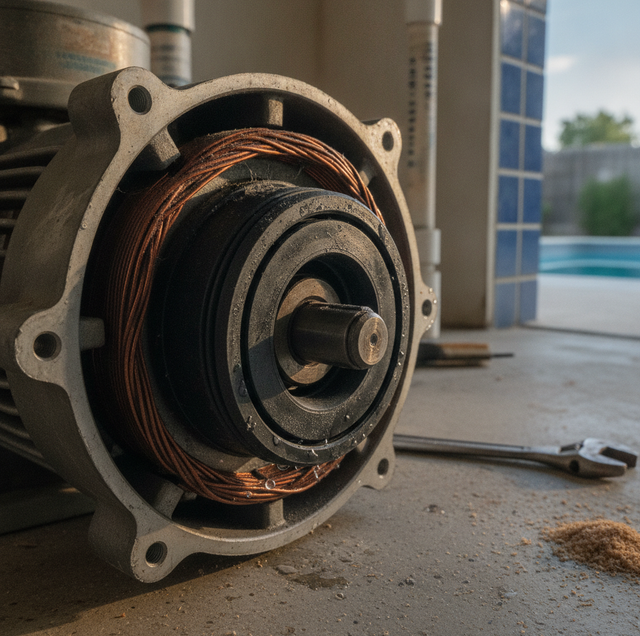
You walk out to the pool, notice the water looks still, and find the pump silent again. The GFCI has tripped. You push the reset button, the motor hums back to life, and a day or two later, you are right back at the equipment pad doing the same thing. It is annoying, and it is easy to start thinking of that little button as the problem.
It is not the problem. The GFCI is doing exactly the job it was installed to do, and the repeated trips are its way of telling you something on the pump circuit is letting electricity go where it should not.
Quick Answer: A pool pump trips the GFCI when the breaker senses even a small amount of current leaking to ground instead of returning through the circuit the way it should. On a pool pump, that leak almost always comes down to moisture reaching the motor windings, degraded insulation inside an aging motor, water in the wiring, a failing capacitor, or occasionally a worn-out GFCI itself. Repeated trips mean there is a real leakage path, so the fix is to find and repair the fault, never to remove the protection.
What a GFCI Actually Watches For
A ground-fault circuit interrupter does not count amps or watch for overload the way a standard breaker does. It compares the current flowing out to the pump against the current coming back. In a healthy circuit, those two numbers match almost perfectly, because every bit of electricity that leaves has to return along the same path.
When they stop matching, the GFCI knows some of that current has found another route to ground. Even a very small imbalance, a fraction of what it would take to trip an ordinary breaker, is enough to make it cut power in a fraction of a second. That sensitivity is the whole point. Around a pool, the "other route to ground" could easily be a person standing in wet grass or holding a metal rail.
Think of it like a tollbooth that counts every car entering a bridge and every car leaving it. As long as the numbers match, traffic flows. The moment a car disappears somewhere in the middle, the operator shuts the gate, because a missing car means something went wrong on the span. The GFCI shuts the gate on your pump the instant electricity goes missing.
The Usual Culprits Behind a Tripping Pool Pump
Pool pump motors live a hard life. They sit outdoors, run for hours, and are surrounded by water and chemistry. That environment produces a fairly predictable list of leakage sources.
Moisture inside the motor- This is the one that comes up most often. The pump motor has a shaft seal that keeps pool water on the wet side and out of the electrical side. When that seal wears out or fails, water seeps past it and reaches the motor windings. Water plus energized copper creates a direct path to ground, and the GFCI detects it immediately.
A worn motor with failing insulation- The wire inside the windings is coated in a thin insulating varnish. Years of heat, vibration, and dampness break that coating down. Once the insulation is compromised, current can bleed through it to the motor's grounded metal frame, even without standing water.
Water in the wiring or conduit- The junction box where the pump wiring connects, and the conduit feeding it, are supposed to stay sealed and dry. If a fitting cracks or a cover gasket fails, water seeps in and creates a fault well before it ever reaches the motor.
A failing capacitor- The start or run capacitor helps the motor spin up and keep running. As a capacitor degrades, it can draw current in ways the circuit does not expect, which can be registered as a fault.
Corroded connections- Terminals and splices that have oxidized make poor, resistive contact. In a damp setting, corrosion can create both weak connections and small leakage paths.
An aging or undersized GFCI- Less commonly, the device itself is worn out and trips when nothing on the pump is actually wrong. This is real, but it is the exception, not the first thing to suspect.
Timing Is a Clue Worth Paying Attention To
When the trip happens, it tells an electrician a lot about where to look, so it is worth noticing the pattern before you call anyone.
If the pump trips the GFCI the instant it tries to start, that points toward a hard fault or a short, a direct low-resistance path to ground that is present the moment power is applied. If, instead, the pump runs fine for a while and only trips after it has been running long enough to warm up, that pattern suggests insulation that is breaking down under heat. Cold windings hold together well enough to pass; once they expand and get hot, the weak spots let go and current leaks.
A third pattern is the trip that only shows up after it rains, or after a heavy morning dew. That timing points squarely at water finding its way into the wiring or the motor, since the fault appears only when moisture is present and clears once things dry out. None of these are diagnoses on their own, but they narrow the search considerably.
Why This Is Not a Nuisance to Work Around
It is tempting, after the third or fourth reset, to look for a way to stop the tripping. The single most dangerous move is to swap the GFCI out for a standard breaker so the circuit stops cutting off.
That does make the tripping stop. It also removes the one device standing between a real electrical leak and anyone near the water. The GFCI was tripping because current was escaping to ground. Take it out, and the current still escapes, but now nothing interrupts it. The path to the ground that the breaker kept catching could be a swimmer touching a ladder, a child leaning on a wet handrail, or someone reaching into the skimmer. Water lowers the body's resistance, making even a modest leak potentially deadly.
Repeated tripping is not the GFCI being oversensitive. It is a working safety device reporting a fault that has not been fixed yet. The right response is to fix the fault so the device stops searching for one, not to silence it.
How a Pro Sorts It Out
Because the causes overlap and the environment is wet and electrified, this is licensed-electrician territory, not a homeowner's troubleshooting job. A qualified electrician works methodically rather than guessing.
They start by ruling in or out the most common cause, the motor. Using an insulation-resistance test, often called a megohm test, they measure whether current is leaking from the windings to the motor frame. A healthy motor reads very high resistance; a wet or degraded one reads low, which confirms the leak is inside the motor. Because the motor is statistically the likeliest offender, checking it first usually settles the question fast.
From there, they inspect the wiring and the junction box for moisture, damaged insulation, and corroded connections, and they check the capacitor. Only after the pump side has been cleared do they turn to the GFCI itself, testing its response and, if warranted, substituting a known-good device to see whether the trips follow the breaker or stay with the pump. That order matters: it separates a bad motor from a wiring fault from a truly failed breaker, so you replace the part that is actually broken rather than throwing money at guesses.
The repair follows the finding. A failed shaft seal or a motor with breaking-down windings usually means a motor rebuild or replacement. A wiring fault means sealing and repairing the connection. A worn GFCI means a new device. Matching the fix to the diagnosis is what keeps the problem from coming right back.
Frequently Asked Questions
A failed shaft seal is the usual offender. That seal keeps pool water on the wet side of the pump and away from the motor's electrical side; when it wears out, water seeps into the motor windings. That creates a ground-leakage path that the GFCI is built to catch. When a motor is opened up after this kind of failure, it often shows visible rust on internal parts or standing water inside the housing, which confirms the seal was the way in.
Quite a bit, and the exact timing helps a tech schedule the diagnosis to catch the fault in the act. A trip only at the instant the pump starts, or the moment a valve actuates, points to a surge or a hard fault present, the split-second power is applied. A trip that comes on during warm-up, often after roughly 20 to 40 minutes of running once the windings heat and any trapped moisture expands, points instead to insulation breaking down under heat. Noting which window it falls in tells the electrician when to be standing there watching it.
Yes, though it is less likely. GFCIs are electronic devices, and they wear out; an aging one can begin nuisance-tripping even when the pump is fine. An electrician confirms this by measuring leakage on the motor first and, if the motor tests clean, swapping in a known-good GFCI to see whether the trips stop. The pump gets checked ahead of the breaker because a faulty pump is the more common cause, so ruling it out first saves chasing the wrong part.
No, and it is one of the most dangerous shortcuts around a pool. The GFCI is the device protecting people from electrocution in a place full of water and grounded metal. Dropping in a standard breaker stops the tripping only by removing that protection, which hides a real leak instead of fixing it, and leaves anyone in or near the pool exposed to a serious shock hazard the next time they touch a rail or the water.
The key tool is an insulation-resistance test, commonly called a megohm test, performed on the motor windings. It applies a voltage and measures how much current, if any, is leaking from the windings to the grounded motor frame. A high reading means the insulation is intact; a low reading means current is escaping, which pinpoints a wet or degraded motor and distinguishes it from a wiring problem or a bad breaker before any parts are replaced.
Yes, and it is often the slow background reason that a circuit that ran fine for years starts giving trouble. The air around pool equipment is damp and carries chlorine and other chemical residue, and that combination corrodes wire terminals and connections while gradually breaking down motor seals and winding insulation. The leakage faults it produces accumulate over time, which is why an older pump in that environment tends to trigger GFCI trips even without a single dramatic failure.
Book a licensed diagnostic for your tripping pool pump circuit — get the fault found and fixed safely instead of resetting the breaker every day. Kennedy Electric serves Citrus, Hernando, and Pasco Counties. License #EC13011268. Call (352) 251-2795.
