

What to Look for in a Whole-Home Rewire Assessment
A house built decades ago was wired for a much smaller life than the one running through it now. Maybe a handful of lamps, a radio, a window unit if you were lucky. Today that same set of wires is asked to carry a refrigerator, a microwave, three phone chargers, a router, a window AC, and a space heater in the back bedroom, all without ever being asked whether it can. Somewhere between "it still works" and "it's starting to worry me" sits the question of whether a home actually needs a full rewire, and that question deserves more than a guess from across the room. It deserves an assessment, and knowing what a good one covers is the difference between a real answer and a sales pitch dressed up as one.
Signs a Home May Be Overdue for Rewiring
Wiring doesn't usually announce that it's failing. It leaves clues, and most homeowners collect a few of them for years before connecting the dots.
Age of the wiring: Copper wiring installed under older code cycles can still function, but insulation degrades over time, especially in attics that swing between summer heat and winter cold. Once insulation gets brittle, it cracks instead of flexing, and a wire with cracked insulation is one accidental nail or one mouse away from a short.
Aluminum branch wiring: Homes wired in the era when copper prices spiked sometimes used aluminum for branch circuits instead. Aluminum expands and contracts more than copper as current flows through it, which loosens connections at outlets and switches over time. A loose aluminum connection runs hot, and it does so quietly, often for a long stretch before anything visible changes.
Frequent breaker trips: A breaker that trips once during a lightning storm isn't telling you much. A breaker that trips every week, especially without an obvious overload like a space heater and a hair dryer running together, is describing a wire or connection that can't reliably carry what's being asked of it.
Discoloration around outlets or switches: A faint brown or black stain around an outlet cover, or a switch plate that feels warm, points to heat building somewhere it shouldn't. Heat at a connection point means resistance, and resistance at a connection point that keeps getting used only gets worse.
Knob-and-tube wiring: Some homes still have sections of the original knob-and-tube system, an early method that ran individual conductors through ceramic knobs and tubes rather than a modern cable. It wasn't designed to be wrapped in insulation, share a junction box with grounded circuits, or carry today's load, and its presence anywhere in a home is one of the clearest signals that a full evaluation is worth scheduling.
Two-prong outlets throughout the house: A house with mostly ungrounded, two-prong outlets is describing its own electrical system almost as plainly as a label would. Grounding matters for more than plugging in a three-prong appliance; it's a safety path built into the system on purpose.
None of these signs alone guarantees a full rewire is the only answer. Together, though, they're exactly what an assessment is built to sort out.
What an Electrician Actually Checks During the Assessment
A real assessment isn't a walk-through with a flashlight and a shrug. It follows a sequence, and each step answers a specific question about the house.
Panel Capacity and Condition
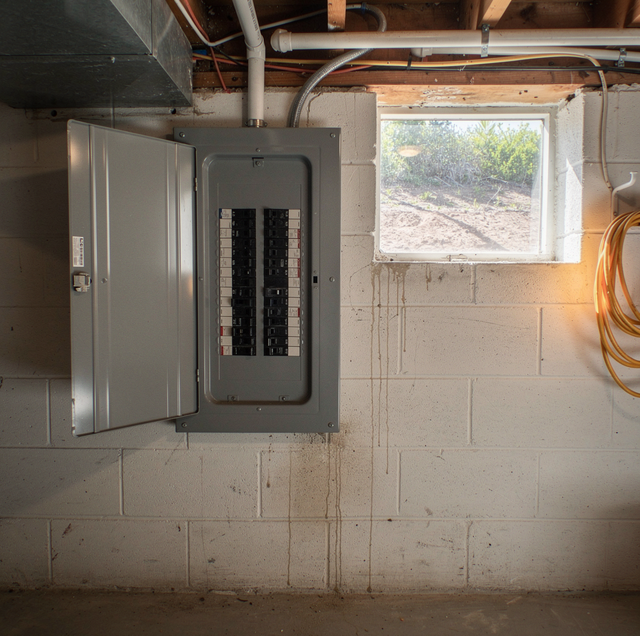
The panel is where the assessment usually starts, since it sets the ceiling for everything downstream. An electrician looks at the main breaker's rated capacity, how many circuits are already in use, whether there's room for the panel a modern home needs, and whether the panel itself, its bus bar, breakers, and connections show any signs of heat damage, corrosion, or wear. A panel that's maxed out or already showing stress changes the scope of the project before a single wall gets opened.
Wire Condition and Type
Next comes the wiring itself, checked wherever it's visible: in the attic, the crawlspace, the basement, and behind any accessible panels or fixtures. This is where aluminum branch circuits, knob-and-tube remnants, and insulation that's cracked, chewed, or brittle get identified and mapped. An electrician also checks wire gauge against the loads it carries, since a wire sized for a small appliance decades ago may now be feeding something that draws far more current.
Grounding
Grounding gets its own line item because it's often invisible from the outlet cover. An electrician verifies that circuits are properly grounded back to the panel and to a real grounding electrode, not just to a three-prong outlet that looks grounded but isn't wired that way behind the wall. This matters for safety and for whether sensitive electronics and GFCI or AFCI protection can function as intended.
Outlet and Circuit Count Versus Modern Load
A home wired for a smaller household often has too few outlets per room, too few dedicated circuits for major appliances, and too much reliance on extension cords and power strips to do a job the wiring should handle instead. An electrician counts circuits per room, checks whether the kitchen, bathroom, and laundry areas have the dedicated circuits they need, and compares the total outlet count to what a household actually uses day-to-day. A shortage here doesn't always require ripping out walls, but it's a factor in deciding how far the project needs to go.
Quick-reference: what shows up in the assessment and what it usually means.
| What's Checked | What It Reveals |
|---|---|
| Main panel rating and condition | Whether the electrical system has room to grow or is already at its limit |
| Wire type (copper vs. aluminum vs. knob-and-tube) | Whether existing wiring can stay in place or needs replacing |
| Insulation condition | Whether wiring is a fire risk from cracked or brittle coating |
| Grounding path | Whether outlets and circuits are actually safe, not just labeled that way |
| Outlet and circuit count | Whether the home's layout matches how it's actually used today |
How Scope Gets Staged: Whole-House vs. Partial
Not every home that fails part of an assessment needs every wire pulled out at once. Scope typically falls into one of a few patterns, and a good assessment explains which one fits.
A whole-house rewire makes sense when the wiring itself is the problem across most of the home: widespread knob-and-tube, aluminum branch circuits throughout, or insulation that's degraded broadly rather than in one spot. In these cases, addressing one room and leaving the rest is patching a system that's failing as a whole.
A partial rewire fits when the problems are contained: one section added on later with wiring that doesn't match the rest, a kitchen or laundry area that's never had the dedicated circuits it needs, or a single run of knob-and-tube left in an attic while the rest of the home was updated years ago. Staging the work this way tackles the parts that actually need it without opening walls that are already sound.
A panel-first approach comes up when the panel itself is the constraint, undersized, outdated, or already showing wear, while the branch wiring feeding it is in reasonable shape. Upgrading the panel first can solve the immediate safety and capacity issue, with branch wiring addressed in a later phase if the assessment flags specific runs as concerning.
The right stage depends entirely on what the assessment finds, not on a default answer decided before anyone looks at the wiring.
What to Ask For and Expect From a Quote or Assessment Report
A written assessment report should read like a diagnosis, not a sales flyer. It should name what was inspected, what condition it was found in, and what that condition means for safety and capacity, room by room or system by system where it matters. If a report only lists a total and a recommendation with no explanation connecting the two, that's worth questioning before agreeing to anything.
Reasonable things to ask for going in:
- A breakdown of what was inspected directly versus what was inferred from age or building records, since not every wire in a wall can be seen without opening it.
- A clear explanation of why whole-house, partial, or panel-first scope was chosen for the home specifically.
- What happens if additional problems, hidden wiring, or existing damage are discovered once walls are opened.
- How the work will be staged if it happens in phases, and what parts of the home stay functional during each phase.
- Confirmation that any completed work will be inspected and signed off according to applicable code requirements.
A well-done rewire assessment gives a homeowner something concrete to act on: a specific list of findings, a specific reason for the recommended scope, and a specific plan for getting from the current wiring to a system that matches how the home is actually used. That's worth more than a fast estimate that skips the explanation and goes straight to a number.
Frequently Asked Questions
Most assessments take a few hours for an average-sized home, longer if the attic, crawlspace, and panel all need to be accessed and if the home has additions or renovated sections with wiring that doesn't match the rest. A home with extensive hidden or inaccessible wiring may require a follow-up visit once specific areas are opened for closer inspection.
Sometimes, if the aluminum wiring in question is limited to a section that's been properly addressed with approved connectors or devices designed for aluminum-to-copper transitions. An assessment should specify exactly which circuits are aluminum and whether they've already been treated correctly, rather than treating all aluminum wiring as automatically disqualifying.
Yes, a complete assessment looks at where power enters the home, not just what's inside the panel and walls. The service entrance conductors, the meter base, and the connection point all affect the home's capacity and whether the entry point itself is in sound condition.
A thorough assessment checks representative areas throughout the home even if one room is the reason for the call, since wiring problems in an older home are rarely confined to a single room by coincidence. What starts as a concern about one bedroom sometimes turns up a shared issue, like an aging subpanel, that affects more than the room where it was first noticed.
Knob-and-tube wiring is a common reason insurers ask questions or adjust terms, since it wasn't designed for modern loads or for insulation coverage. An assessment that documents exactly where it exists and what condition it's in gives a homeowner something specific to bring to an insurer or to a future buyer, rather than an open question with no clear answer.
Yes. A general home inspection usually gives a broad pass or flag on the electrical system as part of a wider report covering the whole house. A dedicated rewire assessment goes deeper on that one system specifically, tracing wire types, testing grounding, checking panel capacity in detail, and producing findings aimed at answering one question: does this wiring need to be replaced, and if so, how much of it?
Schedule a whole-home rewire assessment — a licensed electrician documents your panel, wiring condition, and grounding, then lays out exactly what your home needs and how the work would be staged. Kennedy Electric serves Citrus, Hernando, and Pasco Counties. License #EC13011268. Call (352) 251-2795.
