Generator Interlock vs. Transfer Switch: What’s the Safer Way to Connect?
Quick Answer: An interlock kit is a mechanical block installed on your main panel that physically stops the main breaker and a generator breaker from being on at the same time, so you switch power sources by hand with a couple of breaker flips. A transfer switch is a separate box wired between the panel, the utility feed, and the generator that isolates a set of circuits from the grid the moment you flip its selector, and an automatic version does that switching on its own. Both block backfeed when installed correctly. The interlock costs less and touches your panel less; the transfer switch runs more circuits at once, isolates them completely from the rest of the panel, and can restore power without anyone home to flip anything.
The power drops mid-storm; the generator is fueled and ready in the garage, and the only thing standing between a dark house and a running refrigerator is how that generator is actually connected to your wiring. Extension cords through a cracked window handle a lamp and a phone charger, but they will not run a refrigerator, a sump pump, and a few lights at once. The two accepted ways to connect a portable or standby unit to your panel are an interlock kit and a transfer switch, and choosing between them means understanding how each prevents backfeed, what code requires, and how much panel work is involved.
Why Backfeed Is The Problem Both Devices Solve
Before comparing the two, it helps to understand the danger they both exist to prevent. Backfeeding occurs when a generator is connected to a panel via a wall outlet with a makeshift cord or a breaker not intended to carry generator current, and nothing blocks the path back to the utility line. Electricity from the generator does not stay inside your house; it travels backward through your panel, out through the meter, and onto the same lines utility crews assume are dead while restoring power. A lineman touching what should be a de-energized wire can be seriously injured or killed by power coming from a generator running behind a closed door nearby.
The same backward path is also a fire risk once the grid comes back online. Two power sources meeting on the same circuit without isolation can overload wiring never rated for that combined load, and the failure often happens inside a wall where nobody sees it until it is already burning. Every legitimate connection method exists to make the backward path physically impossible, rather than relying on someone to remember the correct breaker order during a stressful outage.
How An Interlock Kit Physically Blocks Backfeed
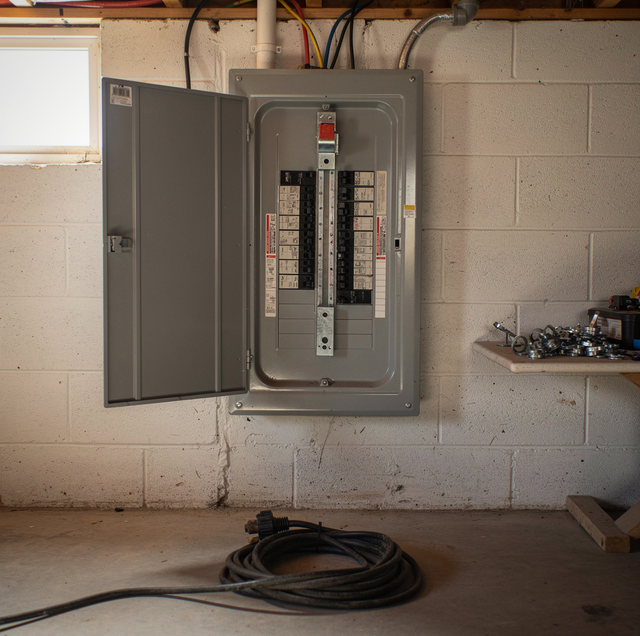
An interlock kit is a small metal or plastic bracket that mounts on the face of your main panel, over the main breaker and a generator breaker installed in an adjacent slot. The bracket is shaped so that only one of the two breakers can be switched on at any given time. Flip the main breaker off, slide the interlock plate, and the generator breaker becomes accessible; the main breaker is now physically blocked from moving back on until the generator breaker is off again. There is no electronic sensing, no timer, no automation, just a piece of metal doing a job that would otherwise depend on human memory.
Using one means a manual routine every outage: shut off the main breaker, connect the generator through its dedicated inlet, slide the interlock, flip the generator breaker on, then switch on only the circuit breakers you want the generator to carry. When utility power returns, the sequence runs in reverse.
How A Transfer Switch Physically Blocks Backfeed
A transfer switch is a separate enclosure, mounted near the main panel, that contains its own small set of circuits, the ones you have chosen to keep alive during an outage: maybe the refrigerator, a sump pump, some lighting, and a furnace blower. Each circuit is wired directly into the switch's own mechanism rather than run through the main panel's normal breakers, so it can connect to only one power source at a time, utility or generator, and both cannot be live at once on any of those circuits. A manual transfer switch has a lever or set of switches you operate by hand. An automatic transfer switch, paired with a standby generator, senses the moment utility voltage drops and switches those circuits over on its own, usually within seconds, then switches them back once grid power stabilizes.
Side-By-Side Comparison
| Factor | Interlock Kit | Transfer Switch |
|---|---|---|
| Backfeed prevention | Mechanical block prevents main and generator breakers from being on together | Dedicated switch isolates each connected circuit from utility power |
| Operation | Manual every time: main off, generator on, in sequence | Manual (flip a lever) or automatic (senses outage and switches itself) |
| Circuits covered | Whole panel, but you choose what to energize breaker by breaker | A pre-selected subset wired directly into the switch box |
| Code compliance | Accepted in most jurisdictions when the kit is UL-listed for the specific panel model | Required in some jurisdictions for permanent generator hookups; always requires a permit |
| Install complexity | Adds a bracket and one breaker to the existing panel | Adds a new enclosure and separate wiring for each connected circuit |
| Labor and material scope | Lower, limited panel modification | Higher, more wiring and a larger footprint |
| Everyday convenience | You operate it by hand every outage | Manual version still needs hands-on operation; automatic version needs none |
| Best paired with | Portable generators | Portable generators (manual) or standby generators (automatic) |
Code Compliance Considerations
Local electrical code and utility interconnection rules govern which setup is acceptable, and the details vary by jurisdiction, so a licensed electrician pulling a permit is the way to confirm what applies to your specific panel. Interlock kits are widely accepted, but only when the kit is listed for your exact panel make and model. A generic bracket bent to fit is not a substitute for a kit engineered and tested for that panel; inspectors check for the listing label, and insurance claims after a fire can turn on whether the hardware matched the panel it was mounted on.
Transfer switches are the long-standing, widely recognized method and are often the only option code allows for a permanent standby installation. Either way, a permit and inspection are standard for a generator hookup involving panel work, because the inspector confirms the exact purpose of both devices: that backfeed is physically impossible at every switch position.
Installation Complexity
An interlock kit is the lighter lift. An electrician sizes the correct kit for your panel, adds a breaker if one is not already installed for a generator circuit, mounts the bracket, and wires an inlet box outside the house where the portable generator plugs in. Most of the existing panel stays untouched.
A transfer switch involves more decisions and more wiring. Someone has to decide which circuits get backup power, since only circuits physically wired into the switch box are protected, and each gets rerouted from the main panel into the new enclosure. That means more conductors, more terminations, and a larger piece of equipment on the wall. An automatic transfer switch paired with a standby unit adds sensing and control wiring on top of that, plus coordination with the generator's own control board.
Cost Factors To Weigh
Without getting into dollar figures, a few conceptual cost drivers separate the two. Labor scales with how much wiring has to be added or rerouted, and an interlock kit generally touches less of the existing panel than a transfer switch, which tends to keep labor lower. Material cost scales with hardware size and type: a bracket and an inlet box are a smaller purchase than an enclosure with its own internal switching for several circuits.
The number of circuits you want protected also drives cost. An interlock lets you flip on as many breakers as the generator can handle at no added hardware cost per circuit, while a transfer switch's cost tends to rise with each circuit wired into the box. An automatic transfer switch paired with a standby generator is the larger project overall, once the generator, its pad, fuel-supply work, and control wiring are factored in.
Everyday Convenience And Operation
This is where the two setups diverge most in daily reality. An interlock kit means someone has to be home, awake, and willing to walk through the shutdown-and-startup sequence correctly every time the power goes out, storm or not. Skip a step, and the convenience disappears until someone corrects it.
A manual transfer switch is a bit quicker day-to-day, since flipping a lever beats the full breaker sequence that an interlock requires, but it still requires a person to be present. An automatic transfer switch removes the human step entirely: sensors detect the outage, the switch disconnects the protected circuits from the grid, the generator starts, and power resumes, often before anyone has found a flashlight. That hands-off behavior is why automatic switches pair almost exclusively with standby generators rather than portables that still need someone to fuel and start them.
Making The Call For Your Home
The choice usually comes down to how you already use or plan to use a generator, not which device is objectively better. If a portable generator lives in the garage for occasional outages and a startup sequence does not bother you, an interlock kit is a lighter, less invasive way to connect it safely. If you want power to come back automatically, without anyone flipping anything, especially for a household with someone who depends on medical equipment or a well pump that has to keep running, a transfer switch, likely the automatic kind paired with a standby unit, is built for that job.
Either path starts the same way: a licensed electrician evaluates your panel, sizes the generator to the loads you want covered, and installs hardware that makes backfeed physically impossible rather than something you have to remember to prevent, confirming along the way what local code requires for your specific setup.
Frequently Asked Questions
It is not a good idea, even though the hardware looks simple. The kit has to be listed specifically for your panel's make and model, the generator breaker has to be sized and installed correctly, and the outside inlet has to be wired to code. Get any of that wrong, and the interlock can fail at the one job it exists for: blocking the main and generator breakers from being on at the same time. A licensed electrician confirms the kit matches your panel and pulls the permit for inspection.
In nearly every jurisdiction, yes, because a transfer switch reroutes circuit wiring and connects a secondary power source to your home's system. The permit process has an inspector confirm the isolation between utility and generator power is wired correctly before it gets covered up. Skipping it does not make the work less risky; it just means nobody independently checked that the backfeed protection is doing its job.
Both can, though an interlock kit is the more common pairing since it is built around someone manually connecting a portable through an outside inlet and flipping breakers by hand. A manual transfer switch also works with a portable and is slightly quicker to operate. An automatic transfer switch is built for a generator that starts itself, generally a standby unit rather than a portable that needs manual fueling and starting.
Extension cords through a window or door power a lamp or small appliance safely enough, but they are not a substitute for either device at the panel. Cords cannot carry a load safely for long, cannot cover multiple circuits at once, and do nothing to stop someone from also plugging the generator into a wall outlet as a shortcut, exactly the backfeed scenario both devices are built to make impossible.
Start with what has to keep running during a multi-day outage: refrigeration, a sump pump if flooding is a risk, some lighting, and a furnace or window-unit blower motor. An interlock kit lets you flip on individual breakers up to what the generator can handle, so the count can flex from outage to outage. A transfer switch's protected circuits are fixed at installation time, so that list needs to be settled before the wiring goes in.
Both are reliable when the correct hardware is matched to the panel and generator, and both benefit from an occasional test run rather than sitting untouched for years. An interlock has fewer moving parts, but it depends on a person operating it correctly every time. An automatic transfer switch has more components and control logic, more that could eventually need service, but it removes human error from the switching sequence. Routine testing and a periodic check by an electrician keep either one working when an outage hits.
Schedule a free estimate for an interlock kit or transfer switch installation — get expert guidance on which setup best fits your generator and panel, and have it installed to code by a licensed electrician. Kennedy Electric serves Citrus, Hernando, and Pasco Counties. License #EC13011268. Call (352) 251-2795.
