

Dead Outlets, No Tripped Breaker? The Hidden Reset
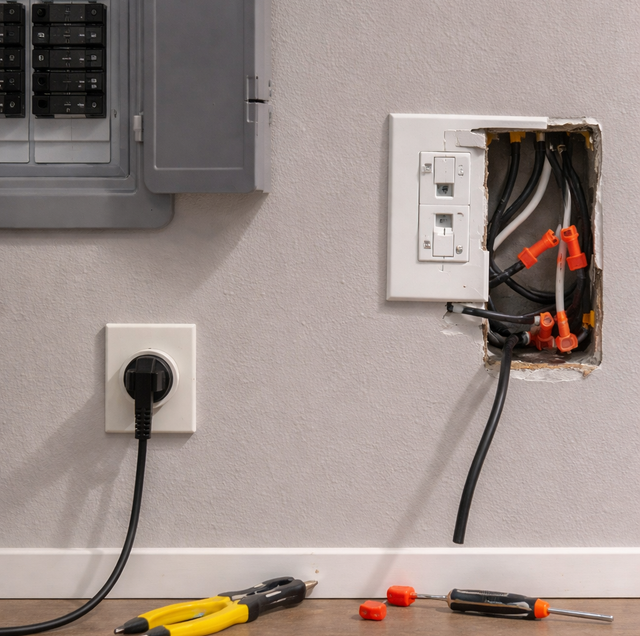
Quick Answer: When a group of outlets goes dead but no breaker looks tripped, the most common cause is a tripped GFCI outlet somewhere upstream that feeds the rest of the run. Find and reset it first. If that fails, a breaker that only moved slightly, a loose or failed connection, or a burned-out outlet in the middle of the chain can break power to everything past it.
You reach to plug in the coffee maker, and nothing happens. The lamp two rooms over is dead too, and so is the phone charger in the hallway. You walk to the panel expecting to see a breaker sitting sideways, but every switch is lined up neat and firm. Nothing looks wrong, yet half the outlets in the house have gone quiet. This is one of the most common calls an electrician gets, and the good news is that the cause is usually simple, findable, and often something you can reset yourself in a couple of minutes.
How Outlets Are Wired So One Failure Kills Several
To understand why one dead spot can take out a whole string of outlets, it helps to know that receptacles on a circuit are rarely wired one at a time back to the panel. Instead, they are connected in a chain. Power arrives at the first outlet, and from there it passes through to the next one, then the next, and on down the line. Electricians call this a daisy chain, and it is the standard way a circuit feeds a room or a group of rooms.
The chain works a lot like a strand of older holiday lights where every bulb depends on the one before it. If any single point in the run loses its connection, everything downstream of that point goes dark, even though the outlets themselves are perfectly fine. That is why a fault at one receptacle, or at one protective device, can silence a whole section of the house while the panel gives you no clue.
Two ways power passes through an outlet matter here. Some electricians pigtail the wires, meaning the incoming and outgoing wires are joined with a wire nut and a short jumper runs to the outlet. Others land the wires directly on the outlet's screw terminals, so the device itself carries the current through to the next box. When the outlet is the pass-through point, a failure at that one device can break the chain for everyone after it.
The Causes, From Most Likely to Least
A tripped GFCI outlet feeding the dead ones: This is the number one reason for the mystery, and it is worth checking before anything else. A GFCI outlet, the kind with the TEST and RESET buttons, does not only protect itself. It very often protects and feeds a string of ordinary outlets downstream. When the GFCI trips, it cuts power to itself and to every outlet wired past it, so a single tripped device in the bathroom can kill outlets in the garage, the patio, and a bedroom that seem unrelated.
The catch is that the GFCI doing the protecting may be nowhere near the dead outlets. Walk your bathrooms, the kitchen counter, the garage, the laundry area, and any outdoor or patio receptacles. Look for a GFCI with its RESET button popped out, then press RESET firmly until it clicks and stays in. In many homes, that one press brings a whole group of outlets back to life.
When you hunt for the tripped GFCI, do not limit the search to the room with the dead outlets. A single GFCI in a bathroom, garage, or laundry area often feeds receptacles in completely different rooms, so check every one in the house.
A breaker that tripped without looking tripped: A breaker does not always slam fully to the OFF side when it trips. Sometimes it moves only slightly, landing in a soft middle position that looks almost identical to ON. From across the room, the panel looks perfect. The fix is to grab the suspect breaker, push it firmly all the way to OFF until it clicks, then back to ON. That full cycle is the only way to reset it; nudging it toward ON from the middle position will not restore power.
A loose or backstabbed wire, or a failed connection: Many outlets offer a fast install option where the wire is pushed into a small hole on the back, gripped by an internal metal clip. This is called backstabbing, and while it is legal and quick, that tiny metal contact can loosen and lose grip over years of heat cycling and vibration. When the connection goes intermittent or fails, power stops passing through to everything downstream. A loose wire also arcs, and arcing makes heat, which is where a nuisance turns into a hazard. A connection under a wire nut that was never twisted tight can fail the same way.
A burned-out outlet mid-run breaking the chain: If a pass-through outlet in the middle of the string has overheated, its internal contacts can degrade or char to the point that they no longer carry current forward. The outlet may still look normal from the front, or it may show faint browning around the slots. Either way, once that device fails internally, every outlet past it in the chain goes dead even though the wiring on the wall is intact.
A loose neutral or a bad connection at the panel: Every circuit needs a return path, and that is the neutral wire. A loose neutral anywhere along the run, or a neutral that has worked loose on the panel's neutral bar, can knock out power to part of a circuit and sometimes cause odd behavior like lights that brighten and dim. A loose connection on the breaker itself, or on the neutral bar inside the panel, sits behind a cover that should only ever be opened by a licensed electrician, because the panel carries lethal voltage even when individual breakers are off.
How to Troubleshoot Safely
Start with the steps that need no tools and no covers removed. Work in this order:
Reset every GFCI you can find: Check bathrooms, kitchen, garage, laundry, and outdoors, and press RESET on any GFCI whose button is out. This clears the single most common cause first.
Look for a partially tripped breaker: At the panel, run a finger along the breakers and feel for one that is softer or slightly out of line with its neighbors. Cycle it fully OFF, then ON. Reset it one time only.
Note what the dead outlets have in common: Are they all on one wall, in adjoining rooms, or on the same side of the house? Outlets that fail together usually share a circuit, and that pattern tells an electrician where the break likely sits.
Check whether a wall switch controls them: Some rooms have outlets wired to a switch by the door, meant for a lamp. A flipped switch, or a bad switch, can make a perfectly good outlet look dead. Try the nearby switches before assuming a fault.
If those steps restore power and it stays on, you are likely fine. If they do nothing, or if power comes back and drops again, the fault is inside a device, a box, or the panel, and that is where the work crosses into licensed territory.
Never keep resetting an outlet circuit that trips again, and stop at once if you smell burning or hot plastic, or find an outlet that is warm, discolored, buzzing, or scorched. That is a fire hazard: a loose connection arcs and overheats, and each reset feeds the fault instead of fixing it. Shut off power to that area at the panel if you can do so safely, and call a licensed electrician.
What Is DIY-Safe and What Is a Red Flag
The safe do-it-yourself steps are the ones that touch only buttons and switches: resetting a GFCI, cycling a breaker once, and testing a wall switch. None of these require opening a box or removing a cover, and all of them are designed to be operated by the homeowner.
Everything past that point belongs to a licensed electrician, and some signs mean you should stop touching things entirely. Treat any of these as a reason to cut power and call for help:
- A burning or fishy, plasticky smell near an outlet or the panel
- An outlet or wall plate that is warm, hot, discolored, or scorched
- Buzzing, crackling, or sparks at a receptacle
- A breaker or GFCI that trips again the moment you reset it, or trips repeatedly
A warm, discolored, buzzing, or scorched outlet, or a burning smell, is a fire hazard. Stop, shut off power to that area at the panel if you can do so safely, and call a licensed electrician. If you see smoke or flame, get out and call 911. A loose connection arcs and overheats, and each reset of a circuit that keeps tripping feeds a fault instead of fixing it. Reset a GFCI or breaker once. If it will not hold, that is a fault to diagnose, not a switch to keep flipping.
Why Opening Outlets and the Panel Is Licensed Work
It is tempting to pull an outlet out of the wall and look, but the wiring behind a dead outlet can still be live even when the outlet itself is not, especially in a chain where power feeds in from a different circuit or a miswired box. The panel is even more serious: the main lugs and bus bars stay energized whenever utility power is present, regardless of which breakers are off, and the space between a mistake and a serious injury is very small.
A licensed electrician carries a voltage tester, knows how to isolate the dead section, and can open devices and the panel safely. Diagnosing a broken chain often means checking connections at several boxes in sequence to find the exact point where power stops, then repairing or replacing the failed device or tightening the loose termination. That is methodical work, and it is far safer and faster in trained hands than guessing with the cover off.
Frequently Asked Questions
Yes. A single GFCI is often wired to protect a long string of downstream receptacles across very different areas, because code allows one device to cover several outlets that need protection. A garage or exterior GFCI commonly feeds bathroom, patio, or even some interior outlets. That is why the tripped device you are hunting for may be in a completely different room from the outlets that went dead.
Repeated resetting will not usually harm the breaker itself, but that is not the concern. If a breaker keeps tripping, it is doing its job by interrupting a real fault such as a short or an overload. Each reset sends current back into that fault, which can heat wiring and connections. A breaker also wears with each trip-and-reset cycle and can eventually fail to trip when it should, so persistent tripping calls for diagnosis rather than another flip.
The quickest home method is to plug a small lamp or a plug-in outlet tester into a working outlet, then switch off breakers one at a time until the tester goes dark. Every outlet that dies with that same breaker is on that circuit. Mapping this out and labeling the panel makes future troubleshooting much faster and gives an electrician a head start.
Backstabbed connections are permitted and often work fine for years, so there is no need to rip out every one. They are simply more prone to loosening than wires secured under the screw terminals, because the push-in clip contacts a small area. If a chain of outlets has failed and backstabbing is found at the break, an electrician will typically move those wires to the screw terminals or pigtail them, which is a sturdier connection for the long run.
Lights that brighten in one area while dimming in another, alongside dead outlets, can point to a loose or open neutral. When the shared return path is compromised, voltage can shift unevenly between circuits that share that neutral, overdriving some devices and starving others. This is a fault worth addressing quickly because the uneven voltage can damage plugged-in electronics, and it needs an electrician to locate and repair.
It could. Many bedroom and living-area circuits are protected by AFCI breakers, which trip on arcing faults rather than ground faults. An AFCI trips at the panel, not at a wall outlet, and its handle behaves like any breaker, sometimes stopping in that hard-to-spot middle position. If no GFCI reset helps and the dead outlets are in living spaces, check the panel for an AFCI that needs a full OFF-then-ON cycle, and note it if it trips again.
Book a licensed diagnosis before you keep resetting — pinpoint the fault and get your outlets back safely. Kennedy Electric serves Brooksville, Spring Hill, and New Port Richey. License #EC13011268. Call (352) 251-2795.
