


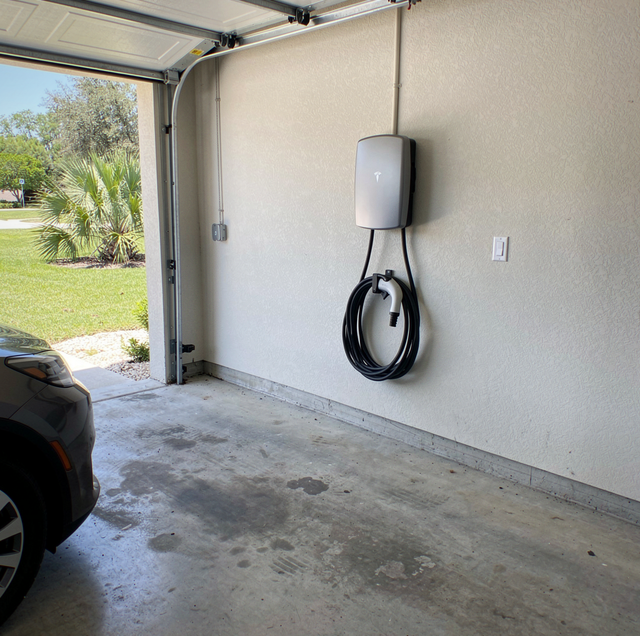
The number that settles this decision is not printed on the box, and it is not the word "Level" followed by a digit. It is miles added per hour of plugged-in time, and across ordinary home installations it ranges from about 3 to about 43. Level 1 and Level 2 name a voltage class, not a speed. Two Level 2 installations on the same street can differ by a factor of three, and the arithmetic behind that gap takes five steps.
Quick Answer: Level 1 adds roughly 3 to 5 miles per hour on a standard 120-volt outlet. Level 2 adds roughly 10 to 43 miles per hour, determined by the circuit's continuous amperage and the ceiling set by your vehicle's onboard charger.
What a Level 1 Cord Delivers
A Level 1 cordset, included with many electric vehicles and sold separately for others, plugs into an ordinary 120-volt household receptacle. It is current-limited by design, most commonly to 12 amps of continuous draw, with some models offering a reduced 8-amp setting.
Multiply the two figures, and you have the delivered power: 120 volts times 12 amps is 1,440 watts, or about 1.4 kilowatts. On a standard 15-amp ceiling receptacle, no adapter raises it. A cordset built for a 20-amp receptacle can draw 16 amps, about 1.9 kW, and that is as far as Level 1 goes.
Some of that 1.4 kW never reaches the battery. The onboard charger converts household alternating current into the direct current the pack stores, and conversion costs energy as heat. Losses of 10 to 15 percent are normal, and they hurt proportionally more at Level 1, where the car's electronics and cooling draw a fixed overhead regardless. Call the useful figure 1.2 to 1.3 kilowatts stored per hour.
The Level 1 cordset requires a dedicated receptacle; never use an extension cord or power strip. A 12-amp continuous draw through an undersized cord or a shared outlet builds heat at connections that were never rated for hours of steady load.
What Level 2 Changes at the Wall
Level 2 changes two variables at once, and both of them multiply.
The first is voltage. A 240-volt circuit presents twice the electrical pressure of a 120-volt receptacle, so the same current moves twice the power. The second is current. A cordset that borrows a general-purpose outlet has to stay modest, but a circuit installed for one purpose can be sized for that purpose, and residential EV circuits are commonly sized at 20, 30, 40, 50, or 60 amps.
Run the multiplication at each rating, and Level 2 lands between roughly two and a half and eight times the delivered power of a Level 1 cord. That spread is why the label alone tells you almost nothing. A 20-amp and a 60-amp installation are both correctly called Level 2, and for a car that accepts the higher rate, one fills it three times faster than the other.
A third level exists: DC fast charging at public stations, but it feeds the pack directly and requires current far beyond what a residential service can supply. It is not a home option, so it stays outside this arithmetic.
Two related decisions also sit outside it. Whether the unit is hardwired or plugged into a 240-volt receptacle leaves the arithmetic below unchanged, with one exception at the top: a plug-in unit is capped by its receptacle; the common 50-amp receptacle stops at a 40-amp charging rate, so the 60-amp row requires a hardwired unit. And the 240-volt circuit itself should be installed by a licensed electrician before any of this math applies to your house.
Why the Circuit Rating Is Not the Delivery Rate
Here is where most speed estimates go wrong. A 50-amp circuit does not deliver 50 amps to a car.
Any load expected to run for three hours or more counts as a continuous load, and a continuous load is limited to 80 percent of the branch circuit's rating. EV charging is the clearest example of a continuous load in a modern home: it draws steadily at its maximum for hours at a stretch. The 80 percent figure exists because conductors, breakers, and terminations heat up over time, and the derating keeps that heat within the range for which the equipment was tested.
So the usable current is always 80 percent of the number stamped on the breaker:
- A 20-amp circuit delivers 16 amps, or about 3.8 kW
- A 30-amp circuit delivers 24 amps, or about 5.8 kW
- A 40-amp circuit delivers 32 amps, or about 7.7 kW
- A 50-amp circuit delivers 40 amps, or about 9.6 kW
- A 60-amp circuit delivers 48 amps, or about 11.5 kW
A second ceiling sits on top of that one. Your vehicle's onboard charger has a rated maximum AC input, and it will not accept more than that no matter what the wall offers. On current full EVs, that limit falls somewhere between about 7 and 11.5 kW, and a few large trucks accept more. The delivered rate is whichever ceiling is lower, the circuit's or the car's. Installing a 60-amp circuit for a vehicle that accepts 7.7 kW buys you nothing today, though it does leave headroom for a future vehicle.
Converting Delivered Power into Miles per Hour
Kilowatts are not miles. The bridge between them is your vehicle's efficiency, expressed as miles per kilowatt-hour, and it varies more than most drivers expect.
Efficient sedans and small crossovers typically return 3.5 to 4 miles per kilowatt-hour in mixed driving. Larger SUVs land closer to 2.5 to 3, and full-size electric trucks often sit between 1.8 and 2.5. Cold weather and sustained heat both push real numbers toward the low end of any vehicle's range, because cabin heating and air conditioning draw from the same pack that moves the car.
The conversion is one multiplication. Delivered kilowatts times miles per kilowatt-hour equals miles added per hour of charging.
| Delivered power | Approximate miles added per hour | Hours to add 40 miles |
|---|---|---|
| ~1.3 kW (120 V, 12 A cordset) | 3 to 5 | 8 to 12 |
| ~3.8 kW (240 V, 20 A circuit) | 10 to 15 | 2.7 to 4 |
| ~5.8 kW (240 V, 30 A circuit) | 15 to 22 | 1.8 to 2.7 |
| ~7.7 kW (240 V, 40 A circuit) | 20 to 29 | 1.4 to 2 |
| ~9.6 kW (240 V, 50 A circuit) | 25 to 36 | 1.1 to 1.6 |
| ~11.5 kW (240 V, 60 A circuit) | 30 to 43 | 0.9 to 1.3 |
Each low end assumes a larger SUV, about 2.6 miles per kilowatt-hour; each high end an efficient sedan near 3.8. A full-size electric truck can sit up to a third below the low figures. The Level 2 rows are figured from power at the wall, so conversion losses put real results a little under them, and any row above your vehicle's onboard limit collapses to that limit.
The Dwell-Time Question: Hours Parked, Not Hours to Full
Time-to-full is the wrong measure, because it describes something you will almost never do at home. Charging from empty is a road-trip event. In a driveway, you are replacing what you spent that day, during hours the car would be sitting still anyway.
The number that matters is dwell time: the hours between when you park and when you leave. For a household that parks in the early evening and leaves in the morning, that window runs 11 to 14 hours on a weekday and more on a weekend.
Multiply dwell hours by miles added per hour, and you get the real capacity of your setup. A Level 1 cord adding 4 miles per hour across a 12-hour overnight window replaces about 48 miles, a larger number than the bare 3-to-5 figure suggests.
Where Each Level Lands for a Real Daily-Mileage Range
Line the two numbers up against how far people actually drive.
Under 40 miles a day: In a sedan or crossover, Level 1 keeps up over a normal overnight window, with margin at the lower mileages. The battery drifts up on light days and down on heavy ones, and the weekend resets it.
40 to 60 miles a day: Level 1 roughly breaks even, with no buffer. A single long day leaves a deficit that the next night barely recovers, and two long days in a row put you behind for the rest of the week. This is the range where Level 2 stops being a convenience.
Over 60 miles a day: Level 1 loses ground every night, and the shortfall compounds. Level 2 on a 40-amp circuit replaces that same 60 miles in roughly two to three hours, which fits inside an evening rather than consuming the whole night.
The compounding matters more than the nightly gap. A 15-mile shortfall is invisible on Tuesday and a 75-mile hole by Saturday.
Do not estimate your daily miles. Read the odometer on two ordinary Mondays two weeks apart, subtract, and divide by 14. If a road trip fell inside those two weeks, take the reading again over a different stretch.
The Conditions That Make Level 1 Enough
Level 1 is sufficient more often than assumed, but only when four conditions hold at once.
Your daily average sits comfortably under about 40 miles. A dedicated 120-volt receptacle already exists within reach of where the vehicle parks, on a circuit that is not also feeding a freezer or a workshop. Your parking window reliably runs 10 hours or longer. And your driving pattern does not include frequent same-day round trips that need a refill before the next morning.
Break any one and the arithmetic tightens. A 9-hour window instead of 12 gives up roughly 12 miles a night. And if no receptacle reaches the parking spot, a circuit has to be run regardless, at which point 240 volts is the more useful option.
Doing the Math for Your Own Commute
Five steps, using your numbers rather than averages.
Step 1: Find your true daily miles: Use the two-week odometer average from the tip above rather than a guess.
Step 2: Find your vehicle's efficiency: The trip computer's lifetime average in miles per kilowatt-hour is more accurate than any published rating.
Step 3: Convert miles to energy: Divide daily miles by miles per kilowatt-hour. That is the kilowatt-hours you have to put back each day.
Step 4: Divide by your dwell hours: The result is the delivered power your household actually requires, in kilowatts.
Step 5: Compare it against the ceilings. Anything at or below about 1.2 kW is inside Level 1's reach. Anything above it needs 240 volts, and the first row in the table that clears your number by at least 10 percent, enough to cover conversion losses, is the specification to take to a licensed electrician.
A worked example: 55 miles a day, a crossover averaging 3.2 miles per kilowatt-hour, and a 10-hour parking window. That is 17.2 kilowatt-hours per night, which requires about 1.7 kW of power. Level 1 falls short by a third. A 20-amp 240-volt circuit clears it with room to spare, and a 40-amp circuit finishes the same job in about two and a half hours.
Run it yourself and the answer often comes back smaller than expected. Plenty of households that assume they need the largest available circuit are served perfectly well by a mid-sized one.
Frequently Asked Questions
Yes, in two ways. The pack's thermal management system runs during charging and, in extreme temperatures, draws a portion of the incoming power to cool or warm the cells rather than store it. Cold weather also raises internal resistance, which slows acceptance. In sustained heat the practical loss is modest, often a few percent, but it is real.
No. Many plug-in hybrids have onboard chargers capped near 3.3 to 3.8 kW and some near 6.6 to 7.4 kW, so a large 240-volt circuit delivers nothing extra to them. Their battery packs are also small, which means a Level 1 cordset can refill a plug-in hybrid completely overnight even though it could not keep up with a full EV.
The battery management system tapers current as the pack approaches its upper state of charge to limit cell stress. On AC charging the taper is gentler than on DC fast charging, but it is still noticeable in the final stretch, where the last 10 percent can take noticeably longer than an earlier 10 percent did.
Some equipment supports power sharing, where two connected units communicate and split the circuit's available current between them. When both vehicles are plugged in, each receives roughly half the rate, and each returns to full rate when the other finishes. It is a way to serve two cars without a second circuit.
The owner's manual lists it as a maximum AC input, given in kilowatts or in amps at 240 volts. The vehicle's charging screen also reports the rate it is currently accepting while plugged in, which is the fastest way to confirm whether the car or the circuit is the limiting factor in your setup.
No. Low-rate AC charging is the gentlest routine a pack experiences, far less demanding than repeated DC fast charging, and it is the right way to handle daily charging for most packs. Many vehicles also let you schedule a start time, so the pack finishes near departure rather than sitting at a high state of charge for hours.
Have your EV charging circuit sized to the rate your vehicle can actually accept — a licensed evaluation matches delivered power to your onboard charger and your actual daily miles, rather than guesswork. Kennedy Electric serves Citrus, Hernando, and Pasco Counties. License #EC13011268. Call (352) 251-2795.