
How Many Surges a Whole-Home Protector Takes Before It’s Spent
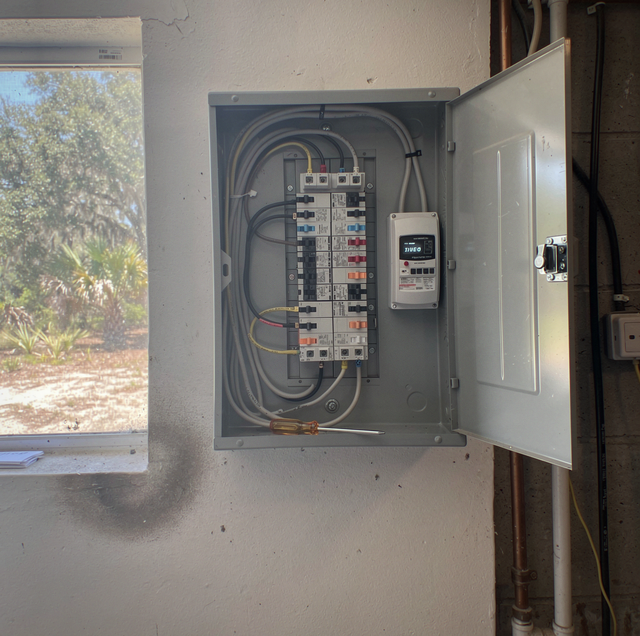
You are at the panel with the cover door open, looking at a small light on the surge protective device wired in beside the breakers. Green, or dark. That is the whole of what the unit shows you without instruments, and the question you are holding is how much it has left.
No single number covers that. A protector built around metal oxide varistors wears out by absorbing energy, and the energy in one transient can be several hundred times that in another, so twenty small events can cost the device less than one close strike coupling onto the service. Counting events treats those as equivalent. What your protector has spent is a quantity of energy, and the light on the front of it does not track that quantity.
What the Status Light Is Wired To
Inside the enclosure, each varistor sits in series with a thermal disconnect: a spring-loaded contact held closed by a low-temperature solder joint against the disc. At normal service voltage, a healthy varistor passes a leakage current in the microamp range and stays cool. As the disc degrades, the leakage increases and warms it, and once the solder softens, the spring pulls the contact open, taking the varistor out of the circuit.
Your indicator is wired to report the state of that path. Lit means the protective path is still connected. Dark, or shifted to whatever fault state your unit uses, means the disconnect has operated, and the varistor behind it is out of service.
That sets the limit on what you can learn standing there. The indicator covers the connection, and it does not move as capacity is consumed. A device that has absorbed nearly all it can absorb shows you the same light as one installed yesterday, and the change arrives at the end of the wear rather than partway along it.
Why the Question Has No Single Number
Surges in low-voltage AC power circuits are sorted by their distance from the service entrance and paired with standard test waveforms, including the combination wave, a 1.2/50 microsecond open-circuit voltage with an 8/20 microsecond short-circuit current.
You can put rough numbers to the spread yourself. The energy a varistor takes from an impulse is close to its clamping voltage times the current through it times the effective duration of the pulse. A 3,000-amp impulse of the 8/20 shape, clamped near 700 volts, is 2.1 megawatts of instantaneous power across roughly 28 microseconds of effective duration, which lands near 60 joules. Run the same arithmetic on the transient a motor throws back onto your wiring as its magnetic field collapses: 50 amps, clamped near 450 volts, for five microseconds is about a tenth of a joule.
Both of those are one surge event, and one is several hundred times the other. That is why no count means anything until someone tells you how big each event was.
How a Metal Oxide Varistor Wears
The disc is a sintered ceramic, zinc oxide grains separated by thin boundary layers. Conduction is controlled at those boundaries, each of which holds off roughly 3 volts before it breaks over, so a disc sized for your 240-volt service stacks roughly 150 of them in series through its thickness.
It is also what wears. Current through the disc does not spread evenly. It follows the lower-resistance paths, which take more of the heating, and each large pulse alters the boundary layers along the paths that carried it. The alteration does not reverse. Measured on a bench, a worn disc shows leakage climbing at normal operating voltage while its breakover voltage drifts down.
Those two changes feed into each other, which is why there is a thermal disconnect. More leakage means more heat in the disc while it sits across your energized service, and a hotter disc leaks more. Left alone, a degraded varistor in your panel can run away thermally and fail destructively. A single impulse beyond what the disc can carry does so faster, cracking or puncturing the ceramic in a single event.
What a Joule Rating Measures
The joule figure on a surge protector's packaging is a single-pulse energy rating from a single test, taken with a long-duration waveform such as the 10/1000 microsecond pulse. It describes what one disc survived once. It is not part of the device's listing tests, and it says nothing about the pulses that follow the first.
Pulse number is what you are asking about, and a varistor's pulse lifetime rating is a family of curves plotting the peak current a disc can take against pulse duration for 1 pulse, 10, 100, 1,000, and 10,000 pulses, and the current allowed at 10,000 pulses is a fraction of what the same disc takes once.
Your unit carries two numbers: a voltage protection rating on the label, which is a clamping level in volts, and a joule figure on the packaging, which is energy from one pulse. Neither is a tally of what remains.
What a listed device carries is a nominal discharge current, In, chosen from 3, 5, 10, or 20 kA, and a voltage protection rating measured with a 6 kV, 3 kA combination wave. The In test consists of 15 8/20 microsecond surges at the rated current, after which it must still limit voltage and function. Fifteen is a real number attached to a real test, and it qualifies the design. Your service does not deliver surges in a controlled sequence at one current. Which device goes in your panel, and whether a point-of-use layer belongs behind it, is a separate question, and it turns on what each layer covers.
How Much Voltage Do the Leads Add?
Inductance in the conductors between the device and the busbar develops a voltage of its own as the surge current rises, which adds to whatever the varistor is letting through. A round conductor runs on the order of 1 microhenry per meter. An 8/20 impulse of 3,000 amps rises in about 8 microseconds, a rate near 375 amps per microsecond, so a meter of lead develops roughly 375 volts on its own. That is why the leads to your device should be short and straight: an extra loop of slack can add more let-through voltage than the gap between two units' protection ratings.
What you cannot establish from outside is remaining capacity. It is internal to the ceramic, and nothing on the enclosure changes as it is used up. Some units are built with plug-in cartridges that carry their own indicators, so a spent module can be swapped without disturbing the wiring.
The Condition That Calls for Replacement
The trigger is the indicator changing state. When it goes dark or moves to its fault color, the disconnect has already operated, and from that moment your panel has no surge protection in it. There is nothing to interpret there.
A replacement interval quoted in years comes from a warranty term or a service policy, and the document that came with your device will say which one. The disc inside keeps a different count, in joules, and it does not reset when the warranty ends.
A unit with no indicator sits differently. There is no signal to miss, so the replacement question rests on its service history and on what has come through your panel since it went in. If a close event took out equipment elsewhere in the house, the protector stood in the path of whatever arrived and is worth examining, lit or not.
Replacing one is panel work. The conductors feeding the main breaker stay energized with that breaker off, so the swap belongs to a licensed electrician, and any permitting question belongs to your local authority. What that leaves you with is a habit: look at the indicator whenever you are at the panel for something else. A unit whose status is brought out to a dry-contact terminal pair can be wired to a monitoring input instead.
Frequently Asked Questions
A typical cloud-to-ground return stroke carries about 30,000 amperes, well above the nominal discharge currents of residential devices. Current from a nearby strike divides among every path to earth it can find, so the protector at your panel takes a share of the total. That share can still exceed what the disc can carry in a single pulse.
Yes. An open neutral on your service does it quickly. With the neutral lost, the two legs split 240 volts between them according to the loads on each, and one leg can sit far above its normal 120 volts for as long as the fault lasts. Varistors conduct continuously under sustained overvoltage, heat steadily, and the thermal disconnect opens. No transient is involved at all.
Not from outside the enclosure. The measurement that means something is the varistor voltage, taken on a component removed from your panel by passing 1 milliamp of direct current through the disc and reading the voltage across it. That value carries a tolerance, and a drift beyond about 10 percent from the original figure is the end-of-life criterion.
No, and that is why the failure is silent. The device is connected in parallel across the conductors it protects, so the current feeding your circuits never passes through it. When the thermal disconnect opens, the device removes itself and nothing else in the panel changes. Every light and outlet behaves exactly as it did the day before.
No. Varistor discs are made in standard diameters, and energy capability scales with the volume of ceramic, so a 14 mm disc that fits inside a strip absorbs several times less energy than the 20 mm and 34 mm discs used in panel units. A strip also takes what your panel device lets through.
A device is classified by where it has been evaluated for connection. A Type 1 is evaluated for the line side of the service disconnect, ahead of your main breaker, and may also be used on the load side; a Type 2 is evaluated for the load side only. That changes what each meets: energy arriving before the breaker, or what got past it.
A dark indicator on a panel surge device is worth an electrician's eyes the same week — replacement is panel work, and the conductors feeding the main breaker stay live with that breaker off. Kennedy Electric serves Citrus, Hernando, and Pasco Counties. License #EC13011268. Call (352) 251-2795.
