


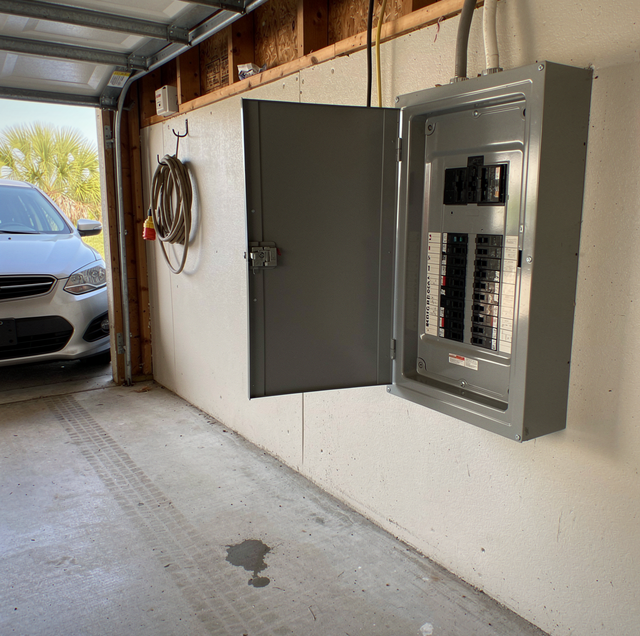
Quick Answer: A home EV charger, especially a 240-volt Level 2 unit, can draw as much continuous current as your air conditioning and electric range combined. Whether your panel can carry that depends on its rated amperage, how much of that capacity your existing circuits already use, and how the charger's load is calculated against the panel as a whole. A licensed electrician answers that with a load calculation, not a guess.
You have picked out a home charger, figured out where the cable will reach in the garage, and the last screen before checkout asks a question you weren't expecting: what size is your electrical panel, and is there room on it for a dedicated 40- or 50-amp circuit? That question isn't a formality. A charger that pulls more current than your panel can spare doesn't just trip a breaker once in a while. It can overload a system that was sized decades ago for a much smaller set of appliances, and the fix isn't something you find by staring at the panel door.
How Panel Capacity Is Measured
Every panel has a main breaker rated for a set number of amps, most commonly 100, 150, or 200 in homes built or updated over the past several decades, with older homes sometimes still running on 60-amp service. That number is the ceiling on how much current the panel can deliver to every circuit inside your house at once: lights, outlets, the air handler, the water heater, the range, and anything else wired into it.
The number stamped on the main breaker isn't a target you're free to use in full, either. Electricians work from the panel's total capacity, minus what's already spoken for by existing circuits, factoring in that some loads run continuously while others only cycle on and off. A 200-amp panel with a houseful of large appliances can have far less real headroom than the number on the door suggests, while a smaller panel with light electric use might have more room than expected. The only way to know which situation you're in is to add up what's actually running against what the panel is rated to deliver.
What an EV Charger Actually Draws
Chargers fall into two practical categories, and the difference between them is large.
| Charger Type | Typical Amperage Draw | Circuit It Needs |
|---|---|---|
| Level 1 (standard 120V outlet) | About 12 amps | Existing 15- or 20-amp circuit |
| Level 2, lower output (240V) | 16 to 24 amps | Dedicated 30- or 40-amp circuit |
| Level 2, higher output (240V) | 32 to 48 amps | Dedicated 50- or 60-amp circuit |
A Level 1 charger plugs into a standard outlet and draws a current similar to that of a window air-conditioning unit. It's slow to fully charge a car, but it rarely asks anything new of the panel. A Level 2 charger runs on the same 240-volt service as an electric range or a central air conditioning unit, and it needs its own dedicated circuit, not shared with anything else. That circuit alone can claim as much amperage as several ordinary circuits combined, which is why a panel that felt fine for years can suddenly feel tight the day a Level 2 charger gets added.
Why a Charger Counts as a Continuous Load
Most household appliances cycle. A refrigerator's compressor kicks on and off. A dryer runs for less than an hour. Even a central air conditioner, which can pull a heavy load especially during long stretches of high heat and humidity, still cycles between running and idle as the thermostat calls for cooling.
An EV charger doesn't behave that way. Once a car plugs in, it can pull its full rated current for hours without pause, which is what electrical code classifies as a continuous load. Continuous loads are held to a stricter standard than a quick-cycling appliance: a circuit is only allowed to carry that load at 80 percent of the breaker's rating, not the full number. A 50-amp breaker feeding a charger is, in other words, only credited with 40 amps of continuous draw for planning purposes. That margin exists because sustained heat over hours behaves differently than a short burst, and a wire that's fine for a few minutes of high current can run hot if asked to hold that same current for an entire overnight charge.
Signs Your Panel Is Already Maxed Out
Some homes show warning signs before a charger ever gets added. A few worth paying attention to:
- Breakers that already trip occasionally when the air conditioner, range, and other large appliances run at the same time.
- A panel with few or no open slots left for a new double-pole breaker.
- A main breaker rated at 60 or 100 amps in a home with central air, an electric range, and other heavy 240-volt appliances already installed.
- A fuse box instead of a modern circuit breaker panel, which is common in older or manufactured housing and generally can't support a large new dedicated circuit at all.
- Wiring you know or suspect is aluminum rather than copper, since aluminum branch circuits carry their own rules and limitations that affect what can safely be added.
- A panel that already feels warm to the touch or has a history of buzzing, both of which point to a system under more strain than it's built for.
Any one of these on its own doesn't rule out an EV charger. Together, they're a strong signal that the panel needs a real evaluation before a charger circuit gets added on top of everything else.
What Happens If You Plug In Anyway
Some homeowners add a charger circuit without ever confirming the panel has room for it, and the results range from mildly annoying to unsafe. The mild version is a breaker that trips whenever the charger runs alongside the air conditioner and other large loads, pointing straight back to too little spare capacity. The more serious version is a breaker that doesn't trip when it should, either sized past what the wiring can actually support, or fed by connections never torqued or sized correctly in the first place. Heat builds in wiring that carries more current than it's rated for, and unlike a tripped breaker, it doesn't announce itself. It builds quietly behind a wall until something fails.
Getting an Answer: The Electrical Load Calculation
The way to answer the capacity question with a number rather than a guess is to perform a load calculation, a standard part of any legitimate EV charger installation. An electrician adds up the demand from every existing circuit, applies the 80 percent continuous-load rule to any loads that qualify, and compares the total to what the main breaker is actually rated to deliver. That produces one of three outcomes: the panel has enough spare capacity for the charger as planned, enough for a smaller one, or none at all, meaning an upgrade comes first.
A load calculation also catches problems a homeowner can't see from outside the panel, like circuits added over the years without ever being reflected in the original load figures, or a main breaker already running closer to its limit than the number on the door suggests. Skipping this step doesn't make the math go away. It just means the panel finds out the hard way, usually on a hot afternoon with the air conditioner running hard and a car plugged in overnight, when every circuit is under the most strain at once.
Your Options When Capacity Falls Short
A load calculation that comes back short doesn't mean a charger is off the table. It means one of several paths forward, and which one makes sense depends on how far short the panel falls and what else is running on it.
A full panel upgrade, swapping a 100-amp main for 150 or 200 amps, gives the most headroom and is often the right call for an older panel that's already tight, especially one still running on a fuse box. It's more involved since it affects the main service equipment, but it solves the capacity problem for the charger and anything else added afterward.
A dedicated circuit run directly from the existing panel works when there's real spare capacity once the math is done, just not an open slot or an obvious place to land the new breaker. This is often the simplest fix when a load calculation comes back favorable.
A subpanel near the garage can solve a wiring-distance problem, though it doesn't create new capacity on its own; the power still comes from the main panel, so a subpanel only helps when that main panel already has room to feed it.
Load management devices offer a middle path when a full upgrade isn't warranted, but the margin is thin. Built into the charger or added alongside it, these monitor overall household demand and automatically reduce the charger's output when other large appliances are running, then let it draw more once they shut off. Instead of sizing the panel for the worst moment when everything runs at once, this lets the charger and the rest of the home share the same finite capacity. The tradeoff is charging speed, not capacity: for a home that's truly short on room, closing the gap directly still matters more.
When to Call an Electrician Before You Buy a Charger
The best time to get an answer on panel capacity is before the charger arrives, not after it's sitting unopened in the garage. A licensed electrician can look at the panel's rating, the age and condition of the wiring, and everything currently drawing from it, then run the load calculation that turns a guess into a number. That visit also catches anything else worth knowing about an older panel: aluminum wiring that needs a specific connection method, a fuse box that rules out a modern EV circuit until replaced, or a main breaker quietly running near its limit longer than anyone realized. Getting that evaluation done first means the charger you buy matches the panel you actually have.
Frequently Asked Questions
Rarely. A Level 1 charger plugs into an existing outlet and draws a load comparable to a window air-conditioning unit, so most panels handle it without changes. The exception is a panel already so tight it can't spare even that modest continuous load, uncommon but not impossible in an older home with heavy existing electric use.
Sometimes, but it depends on how much spare capacity the panel has after the first charger's circuit is accounted for. Two Level 2 chargers together can draw as much continuous current as several major appliances combined, so a household planning for two vehicles should have a load calculation run for both circuits at once rather than adding the second charger later as an afterthought.
Location affects wiring distance and whether a subpanel makes sense, but it doesn't change how much amperage the charger itself draws. A charger near the main panel and one at the far end of the house pull the same current; the farther one may need larger-gauge wire to avoid voltage drop, a design detail for the electrician rather than something that changes the panel capacity math.
Not automatically. A 200-amp panel provides more headroom than a 100-amp panel, but even a home already running central air, an electric range, and a heat pump water heater can still be close to its limit. The main breaker's rating tells you the ceiling, not how much of it is already spoken for, which is exactly what a load calculation is for.
The concept is simple to describe but easy to get wrong in practice, since it depends on correctly identifying all existing loads and knowing which rules apply to continuous versus intermittent loads. A miscalculation doesn't show up as an obvious error; it shows up later as a panel running hotter than it should. Because the result determines whether a large new circuit can be added safely, a licensed electrician should run the numbers rather than estimate them.
It depends on the panel's condition and rated capacity, not just its age. A panel with enough spare amperage, sound wiring, and no signs of wear can often take a new dedicated EV circuit without other changes. A panel that's a fuse box, shows corrosion or heat damage, or is already running near its limit typically needs attention first, which a pre-purchase evaluation is meant to catch.
Schedule a panel evaluation — a licensed electrician runs the load calculation and tells you plainly whether your panel is ready for an EV charger or needs an upgrade first. Kennedy Electric serves Citrus, Hernando, and Pasco Counties. License #EC13011268. Call (352) 251-2795.