

Why Your Outdoor Outlets Keep Tripping After Rain
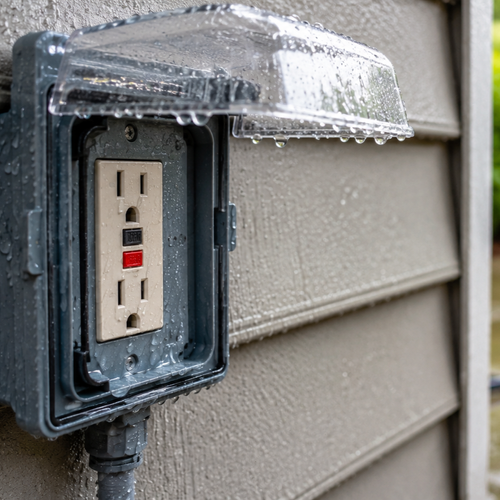
Quick Answer: After rain, an outdoor outlet trips because its GFCI senses electricity leaking where it shouldn't — usually moisture that's worked into the box, the receptacle, or a plug. The GFCI is doing its job: it cuts power in a fraction of a second when it detects a leak as small as 5 milliamps. Let everything dry, then reset it. If it trips again with nothing plugged in, you've got a real fault or a worn-out GFCI, not just a wet one.
You get a break in the storm, head out to plug in the pressure washer, and the outlet's dead. Again. The little "reset" button has popped, the patio lights are out, and it always seems to happen right after a hard rain. That outdoor outlet isn't broken at random — it's protecting you, and the rain is the reason. Once you know what the GFCI is reacting to, the fix is usually simple, and the times it isn't are exactly the times you want to know about.
What the GFCI Is Actually Doing
Every outdoor outlet must be GFCI-protected, either at the outlet itself or at the panel. A GFCI — ground-fault circuit interrupter — constantly compares the electricity flowing out on the hot wire against what returns on the neutral. Those two should match. When they don't, it means current is escaping somewhere along the way, and the GFCI cuts power in about 1/40th of a second.
The trip point is tiny on purpose. A difference of roughly 5 milliamps is enough to shut it off — a fraction of what it takes to stop a heartbeat. That sensitivity is the whole point: out by the pool, the hose bib, or wet concrete, a ground fault is the kind that can kill, so the device errs hard toward cutting power. When your outlet trips after rain, the GFCI is reporting that water has opened up a path for electricity to leak. It's a warning, not a malfunction.
Why Rain Sets It Off
Water conducts electricity, and it doesn't need much of an opening. Wind-driven rain seeps past a cracked cover, runs down a plugged-in cord, or collects in the bottom of the box, and suddenly there's a damp bridge between the contacts and ground. That bridge leaks a few milliamps — exactly what the GFCI is built to catch — and the outlet trips. This is the difference worth remembering: weatherproof doesn't mean waterproof. A weather-rated outlet still trips if the cover that's supposed to keep rain out has failed.
Here's the mechanism behind most "it works once it dries" cases. The moisture sits across the receptacle's terminals while it's wet, leaks current, and trips the device. As the box dries out over a day or two, the leak path disappears and the outlet resets and holds — until the next storm finds the same gap. That repeating pattern is the tell that water is getting somewhere it shouldn't, and that the weatherproofing, not the wiring, is the thing to fix.
Match the Symptom to the Cause
Before you assume the worst, line up what you're seeing with what usually causes it.
| What you're seeing | Likely cause | What to do |
|---|---|---|
| Trips during/after rain, resets once dry | Water reaching the box or plug | Fix the cover/gasket; keep cords out of pooling water |
| Won't reset even with nothing plugged in and dry | Failed GFCI or a real ground fault | Stop resetting; call an electrician |
| Trips only with one device plugged in | That device or its cord is faulted | Replace the cord/device, not the outlet |
| Several outdoor outlets dead at once | One upstream GFCI feeds the rest | Find and reset the first GFCI in the chain |
| Visible rust, scorching, or a cracked cover | Corrosion or water-damaged box | Replace the receptacle and cover |
The Fixes That Actually Solve It
Start with the cover, because it's the usual culprit. Outdoor outlets in wet locations are supposed to have an "in-use" cover — the bubble-style hood that stays weatherproof even with a cord plugged in — rather than the flat flip-lid that only seals when empty. If yours is the flat kind, cracked, or missing its gasket, water has a clear way in. Swapping to a proper extra-duty in-use cover, with a weather-resistant receptacle behind it, solves a large share of rain trips on its own.
Next, look at what you're plugging in and where the water goes. A cheap extension cord with a worn connector, holiday lights left out all season, or a downspout and sprinkler aimed near the outlet all feed moisture straight to the contacts. Move cords up out of puddles, and redirect water that's splashing the box.
One safety rule that isn't optional: never reset a GFCI on a wet outlet. If the box is still damp, killing the breaker and letting it dry fully is the move — resetting into standing water is how a nuisance trip becomes a shock. And skip the duct-tape-and-plastic-bag patches; they trap moisture instead of shedding it.
GFCIs wear out. Most have a service life of around 10 years, and a tired one trips more easily and resets less reliably. Press the TEST then RESET buttons once a month — if it won't trip on TEST or won't hold on RESET, replace it regardless of the weather.
When It's a Real Fault, Not Just a Wet One
The line to watch is simple: a GFCI that trips wet and resets dry is doing exactly what it should. A GFCI that won't reset even when everything is dry and unplugged is telling you something else — a genuine ground fault in the wiring, a corroded box, or a device at the end of its life. At that point, repeated resetting isn't troubleshooting; it's overriding a safety device that's trying to warn you. That's the call for professional troubleshooting to find the fault rather than fight the symptom.
There's a storm angle here that matters along Florida's Gulf Coast specifically. Florida is the lightning capital of the country — the western peninsula, including the Hernando, Pasco, and Citrus County corridor, averages 80-plus days a year with thunderstorms, and the state sees well over a million cloud-to-ground strikes annually. All that rain and lightning means outdoor circuits here take more abuse than almost anywhere else, and a nearby strike can spike a circuit and damage a GFCI outright. If outlets started misbehaving right after a lightning storm, the device may have taken a hit, and whole-home surge protection is worth a conversation.
Frequently Asked Questions
Use it only after it resets and holds with the box dry. The tripping itself is the safety system working, so don't defeat it. If the outlet won't stay reset, leave it off and have it checked — a circuit that keeps faulting near water is exactly the hazard the GFCI exists to prevent.
Because rain is creating a temporary leak path the GFCI detects. Water gets into the box, the receptacle face, or a plugged-in cord, bridges the contacts, and trips the device until everything dries. A repeating rain-only pattern almost always points to a failed cover or gasket rather than a wiring problem.
No. Let it dry completely first, and if water is pooling, switch off the breaker before touching it. Resetting power into a wet outlet risks a shock and defeats the protection. Once it's dry, press reset; if it holds, the moisture was the issue.
Most run about 10 years, though some fail sooner. They take a beating outdoors from the sun, moisture, and the occasional power surge. Testing yours monthly with the TEST and RESET buttons is the quickest way to catch one that's worn out before it leaves you unprotected.
Outdoor outlets are often wired in a chain off a single GFCI. When that first "upstream" device trips, every standard outlet fed from it goes dead too. Find the GFCI with the popped reset button — often at the first outlet, in the garage, or at the panel — and reset that one to restore the rest.
Yes. A nearby strike can send a surge through the circuit that damages a GFCI or the wiring, which is common in a high-lightning area. If outlets started acting up right after a storm, the device may be damaged rather than just wet, and surge protection at the panel helps guard against the next one.
A Tripping Outlet Is Information, Not a Nuisance
That popped reset button is the cheapest diagnostic your home gives you. Most of the time, it's pointing at a worn cover letting rain into the box — a fix you can see and solve. The times it won't reset dry are the times to stop and call someone, because then it's flagging a fault you can't see. Read it either way, and the outlet does its job: keeping the wet and the wiring apart.
Outdoor outlets that won't stay on after a storm? — Get the cover, receptacle, and circuit checked, and your home set up against the next lightning surge. Kennedy Electric serves Citrus, Hernando, and Pasco Counties. License #EC13011268. Call (352) 251-2795.
