

Subpanel or Main Panel Upgrade: Which Does Your Home Need?
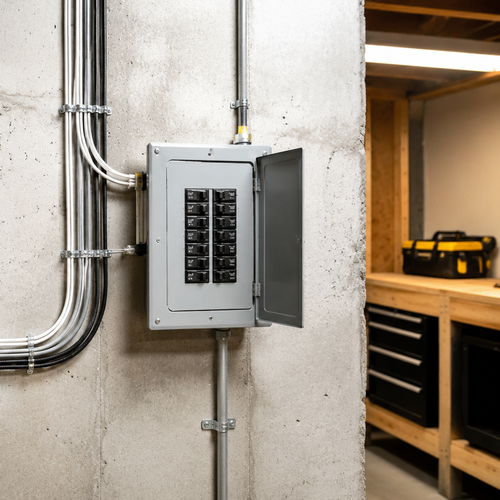
Quick Answer: A main panel upgrade increases your home's total electrical capacity by replacing the main service panel with a larger one, and it's what you need when the whole house has outgrown its electrical service. A subpanel adds more circuit space branching off the existing main panel, and it's the right choice when you have enough total capacity but have run out of room for breakers, or you need a cluster of new circuits in one area like a garage, addition, or workshop. The deciding question is whether you're short on total power or just short on breaker space. An electrician confirms which by evaluating your service size and load.
When a home needs more electrical capacity or more circuits, two solutions come up: upgrading the main panel or adding a subpanel. They sound similar but solve different problems, and choosing the wrong one means either overspending or not actually fixing the issue. The key is understanding what each one does.
What the Main Panel Does
The main service panel is the central hub where your home's electricity arrives from the utility and gets distributed to the circuits throughout the house. It has a main breaker rated for a certain amount of total current — the service size — and a limited number of slots for the individual circuit breakers that feed your rooms and appliances.
Everything in your home draws through that main panel, so its rating sets the ceiling on how much power the whole house can use at once. When that ceiling is too low for modern demands, a main panel upgrade is the answer.
What a Subpanel Does
A subpanel is a smaller panel that branches off the main panel through a single feeder. It provides additional breaker slots and distributes power to circuits in a specific area, without increasing the home's total service capacity. Think of it as extending the main panel's reach rather than raising its limit.
Subpanels are common for additions, detached garages, workshops, and areas far from the main pane,l where running many individual circuits back to the main would be impractical. They add organization and circuit space using the capacity the home already has.
The Deciding Question: Power or Space?
Here's the distinction that decides everything: are you short on total power, or just short on breaker slots?
If the whole house is straining its capacity — the main breaker trips under heavy load, or you're adding major loads like a large air conditioner, an EV charger, and modern appliances that together exceed the service size — you need more total capacity, which means a main panel upgrade. If your home has plenty of total capacity but the panel is simply full, with no open slots for new circuits, a subpanel adds the room you need without touching the service size. And if you're adding a concentrated group of circuits in one location, a subpanel there is often the cleaner solution regardless.
| Situation | What you likely need |
|---|---|
| Whole house trips main breaker | Main panel upgrade |
| Adding several large loads at once | Main panel upgrade |
| Panel is physically full of breakers | Subpanel (if capacity allows) |
| Adding circuits to a garage or addition | Subpanel in that area |
| Old, undersized service overall | Main panel upgrade |
| Need more circuits, capacity is fine | Subpanel |
Why Capacity and Space Aren't the Same Thing
It's easy to assume a full panel means you're out of power, but those are different limits. A panel can be completely full of breakers while the home still uses well under its total capacity — you've run out of slots, not power. Conversely, a panel with open slots can still be at capacity if the existing circuits draw heavily. That's why the fix depends on a real evaluation of both the service size and the actual load, not just a glance at how many empty slots are left. Adding a subpanel won't help a home that's genuinely out of capacity, and upgrading the main panel is overkill if you only needed more breaker space.
Before assuming you need a bigger service, note what's actually overloading things. If one crowded area needs several new circuits but the rest of the house is fine, a subpanel is often the targeted answer. If the whole house struggles under heavy use, the main panel is the real bottleneck.
Why This Is a Job for a Professional
Both options involve working with the home's primary electrical distribution, and getting the sizing and connections right matters for safety. An electrician performs a load evaluation — calculating what your home actually draws and what you're planning to add — to determine whether the home is capacity-limited or space-limited. That assessment is what separates a correct, lasting solution from a guess. It also ensures the work is done to current safety standards, properly permitted, and inspected. Because the main panel handles the full incoming service, this isn't an area for trial and error. The evaluation also looks ahead: a good electrician asks what you plan to add over the next several years, since sizing a solution for today's load alone can leave you upgrading again sooner than you'd like. Planning for future demand once is almost always cheaper and cleaner than doing the work twice.
Frequently Asked Questions
A main panel upgrade replaces your main service panel with a larger one to increase the home's total electrical capacity. A subpanel provides additional breaker space by branching off the existing main panel without increasing the total capacity. One raises the ceiling on how much power the home can use; the other adds room for more circuits using existing capacity.
If the whole house strains its service — the main breaker trips under load, or you're adding major new loads that exceed the service size — you need more capacity via a main panel upgrade. If the panel is simply full of breakers but the home isn't maxing out its power, a subpanel adds space. An electrician's load evaluation confirms which.
Only if the problem is breaker space, not total capacity. A subpanel distributes existing capacity to more circuits; it doesn't increase the amount of power the home can draw. If the home is genuinely out of capacity, a subpanel won't solve it — you'd need a main panel upgrade. That's why diagnosing the real limit first is important.
When you're adding several circuits in one area away from the main panel, a subpanel there is usually the cleaner solution. It lets you run one feeder to the location and branch off it locally, rather than running many individual circuits all the way back to the main panel. Workshops, detached garages, and additions are common examples.
No. A full panel means you've run out of breaker slots, which is a space limit, not necessarily a power limit. The home may still use well under its total capacity. Likewise, a panel with open slots can still be at its capacity limit. Space and capacity are separate, which is why an evaluation looks at both.
Yes, both a main panel upgrade and a subpanel installation are significant electrical work that should be permitted and inspected. This ensures the work meets current safety standards and is done correctly, which matters because these panels handle the home's primary power distribution. A licensed electrician handles the permitting as part of the job.
Match the Fix to the Real Limit
A main panel upgrade raises your home's total electrical capacity; a subpanel adds circuit space using the capacity you already have. The right choice hinges on one question — are you out of power, or out of breaker slots? A proper load evaluation answers it, so you solve the actual problem instead of guessing. Get that diagnosis right, and the upgrade does exactly what your home needs.
Not sure if you need a panel upgrade or a subpanel? — Get a load evaluation that tells you which your home actually needs. Kennedy Electric serves Citrus, Hernando, and Pasco Counties. License #EC13011268. Call (352) 251-2795.
