

Faulty Dock Wiring: The Danger Nobody in the Water Sees
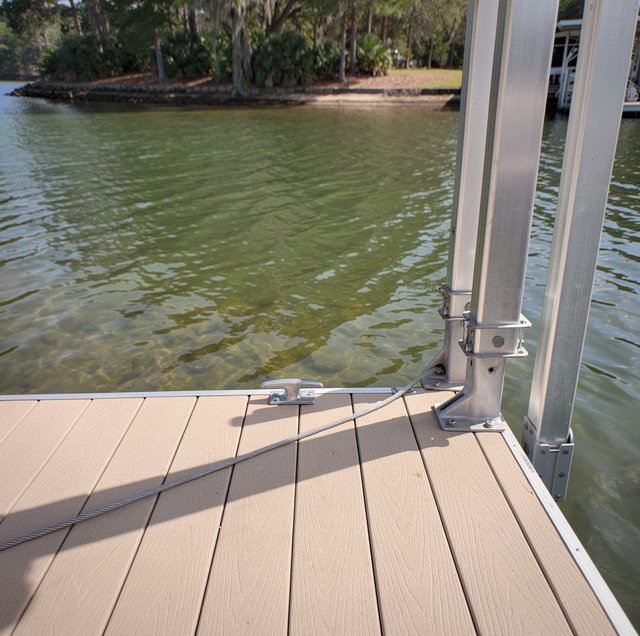
Someone swimming beside your dock can be in trouble while every light on that dock still burns and no breaker in your house has moved. The water carries the fault. The dock never shows it. The gap between what you can see and what is in the water is why this failure affects people who were never in contact with metal.
Dock and boat-lift wiring sits in the worst conditions any circuit at your address faces: constant damp, salt or brackish spray, vibration from a lift motor, and sun on the insulation. When it fails, the current leaving it does not stop at your dock frame. It moves into the water your family swims in, and it spreads from the source in every direction you cannot see.
What Makes the Water Around a Dock Dangerous?
Current escaping into water does not travel in a straight line to one point. It spreads outward from wherever it entered, and it weakens with distance, so two points a body length apart sit at different voltages. A swimmer floating across that difference becomes part of the path between them. The human body conducts better than the water in most lakes and canals, so more of the current passes through you than through the water beside you.
A person caught in that current does not get burned. Electric shock drowning guidance makes it clear that there is no visible warning of electrified water and that the current in the water paralyzes the muscles. On a dock branch circuit, that happens far below the leakage a breaker opens on, and it takes the control you need to keep your head at the surface. Nobody standing on the dock feels any of it.
A Fault Returns Through Whatever Conducts
In a healthy circuit, current goes out on one conductor and returns on the other. When insulation fails somewhere on your dock, the equipment grounding conductor is meant to carry that stray current back to the panel fast enough and hard enough to open the breaker. If that conductor has lost its termination, corroded off a lug, or was never properly landed at the lift motor, the current takes the water rather than the wire, and the breaker never sees enough to trip.
The failure points on a dock are physical and few. A flexible cord feeding a lift motor cracks at the strain relief where it flexes every cycle. A pedestal receptacle collects salt-laden moisture behind its cover gasket. A junction box on a piling floods and its terminations corrode. Any one of them puts a live conductor in contact with water or with the metal your family reaches for.
How Far Can the Hazard Reach From a Dock?
The voltage across the water works like the slope of a hill. It is steepest right where the current enters and flattens the farther out you go, which means the dangerous zone has no visible edge and does not stop at the last piling. A swimmer can cross most of the water without noticing anything and then feel it sharply while closing the last few feet toward a ladder.
That geometry explains why so many of these events happen at the moment someone reaches the dock. Submerged metal concentrates the current: the lift's guide posts, an aluminum ladder, a boat's propeller shaft and its bonded underwater hardware. Reaching for any of them while your body is already in the water puts a hand and a torso at two very different potentials at once.
A swimmer near a dock who feels a tingle or whose muscles tighten should swim away from the dock and the boat. Nobody should enter the water to help: turn off the dock power, call 911, and throw a life ring.
Open Water Cannot Be Bonded Like a Pool Shell
A pool is a bowl. Everything metal a swimmer can reach sits inside a defined boundary and is tied to one potential, so there is no difference for a body to bridge. A pool's boundary is a thing an installer can terminate on. Open water has no bowl and no boundary, and it gives a bonding conductor nothing to land on. The volume that matters keeps shifting with the tide and the wind. The canal or lake your dock stands in runs past your last piling and keeps going, and the water in it takes whatever potential the surrounding earth and any nearby source of current give it, with no perimeter anywhere on it where that difference stops.
Bonding on a dock does the smaller job. It ties the metal you can touch on the structure to one potential, rather than leaving each piece to find its own.
So your dock's own bonding protects a person standing on it and does nothing for a person floating beside it. The water stays outside every conductor an electrician can tie together. That leaves two things carrying the whole load at your dock: keeping the fault from ever reaching the water, and catching leakage the moment it starts to leave your circuit.
A Dock Breaker Cannot Sense the Water Path
An ordinary breaker responds to the current flowing through the conductors it protects. It opens on an overload it can measure and on a short circuit drawing hundreds of amps in an instant. A fraction of an amp bleeding off a cracked cord jacket into the canal water is nowhere near either threshold, so the breaker holds and the circuit works normally.
What leaves through the water is a return path, not a fault current the breaker sees. Closing that blind spot requires a device that compares the current going out with the current coming back and opens on the difference rather than the total draw. On a dock, an electrician puts that protection at the feeder supplying the structure and at the receptacles, sized for the loads actually installed.
Even that protection depends on the rest of the system being intact. A fault upstream of the device, or on a nearby circuit it was never installed to cover, energizes the water while your dock's protection sits undisturbed, because that current never passed through your conductors.
An Inspection Starts With the Dock Energized and Loaded
An electrician evaluating your dock works with the power on, the lift cycling and the boats plugged in, rather than at a dead panel. A cracked cord that only leaks when the motor pulls it tight, or a receptacle that only conducts when its terminations are wet, will look perfect on a de-energized circuit at your panel. The condition being hunted only exists while the thing is running.
The corrections are specific hardware. A lift motor's cord and cord cap are replaced when the jacket opens at the strain relief. A flooded junction box gets fresh terminations and a sealable cover. A pedestal receptacle with green powder on its screws comes out. An equipment grounding conductor that was never landed gets landed, and the ground-fault protection is tested and replaced if it fails to open.
Nothing on the Dock Itself Ever Feels Wrong
A person standing on your dry deck boards is not in the circuit. Dry wood conducts poorly, both feet rest at the same potential, and there is no second point of contact for current to travel toward. The dock gives no warning underfoot, no flicker in the light, no hum, no smell. Wet boards, bare feet and a hand on a metal ladder change that arrangement completely, which is why your dock can feel ordinary all afternoon.
So the fault sits there every day, and nobody gets in, and the first thing that registers it is a person in the water. A dock that has never tripped anything is not evidence of a healthy circuit; it is only evidence that nothing has yet completed the path in a way the panel could measure.
Frequently Asked Questions
Yes. Current in shared water does not respect your property line, and on a canal the source can easily be two or three slips away. This matters most where several slips are fed from a single shore-power pedestal, because a fault on any of them can energize the water everyone swims in. An electrician tracing a hazard at your dock asks what else runs off your supply before assuming the problem is yours.
Replacement often changes the material as much as the part. A non-metallic enclosure goes in on your piling where a metal one came out, because a metal box already collecting brackish moisture becomes one more surface your bonding must account for. One more thing corroding from the inside, in a place nobody looks. Stainless or bronze hardware replaces the plated screws you already have, and every gasket in the run gets renewed while your dock is open.
A boat running its own generator or inverter carries a complete alternating-current system aboard, independent of your dock, with the same insulation, the same terminations, and the same vibration exposure. None of it passes through a dock breaker or a ground-fault device on shore, so nothing ashore trips. A fault in that system finds the vessel's underwater metal and puts current into the water from there. Unplugging your boat from your pedestal removes one source and does not remove your boat.
It runs against intuition, and it comes down to which conducts better, the swimmer or the water around them. Reverse that, and you reverse the outcome: in a brackish or saltwater basin you are the poorer of the two paths, most of the current goes around you, and the same fault registers as nothing worse than a tingle. Brackish water is the awkward case: its salt content shifts with rain and tide, so your dock is not reliably the same hazard twice.
It can, because a generator is a source in its own right with its own grounding arrangement, which may be bonded internally or left floating, depending on the unit. Running cords from it across your wet deck boards to a pump, a light string or a set of tools puts several new terminations in the wettest place on your property. A generator used at your dock deserves the same evaluation as your permanent wiring, because it is doing the same job at the waterline.
Not automatically. A dock with no electrical service holds a great deal of metal in the water beside you, and that metal can act as one end of a path for a fault that started somewhere else entirely: a lift on shore, an irrigation pump on your own property, or a neighboring dock. Because there is no circuit on the structure, there is often no bonding either, so the ladder, the frame, and the pilings sit at whatever potential the water gives your dock.
A dock and boat-lift electrical evaluation by a licensed electrician who works on waterfront wiring — every termination at the pedestal, the lift motor, and the feeder checked with the circuits live and the boats connected, ground-fault protection verified, and anything letting current reach the water corrected before your family swims off that dock again. Kennedy Electric serves Citrus, Hernando, and Pasco Counties. License #EC13011268. Call (352) 251-2795.
