


Quick Answer: One dark room in a working house has lost one branch circuit. Check for an opened breaker or fuse, a tripped GFCI on another wall, then the switches. If none explains it, a failed connection along the circuit needs an electrician.
The bedroom lamp clicks and stays dark. The standby light on the TV is out, the phone on the nightstand stopped charging an hour ago, and the ceiling fan sits still. Step into the hallway and that light comes on the way it always does. Something has cut one room out of the house and left everything else alone, and the shape of what went dark is the first clue to where the break sits.
A Dark Room Means One Circuit Lost Its Supply
Power reaches your home through one service and one main breaker, then divides at the panel into branch circuits. Each branch has its own breaker or fuse, sized at 15 or 20 amps for general lighting and outlet circuits, and each one leaves the panel on its own path through the walls. With the hallway and the other rooms working, the service and the main are fine; what you have lost is one branch, or a piece of one.
Circuits follow the route the wire takes through the framing, and that route pays no attention to where one room ends. Each circuit feeds a string of boxes that are conveniently reachable from one another, so a single circuit might serve every outlet in a bedroom plus the shared wall of the bathroom next door, while the bedroom's ceiling light rides on a different circuit with the hallway. That is why the dark area can stop short of the doorway, or spill a few feet into the next room.
Read that shape before you touch anything. Notice which lights and outlets in the room still work, which do not, and whether anything in the neighboring rooms went out at the same moment. A working ceiling light over a room full of dead outlets tells you the two are fed separately, and the break is on the outlet side. A room that is completely dark, even with the lights on, points to a loss close to the source: a breaker or fuse that opened, or a protective device that feeds the whole room. A dead zone that crosses a doorway, taking the bed wall and the shared wall of the bath next door, is one circuit's run rather than two separate failures, so the search follows that run. One dead outlet or one dark fixture among working neighbors points toward a switch or a single device, which comes last in this order.
Check the Panel First for a Breaker or Fuse That Opened
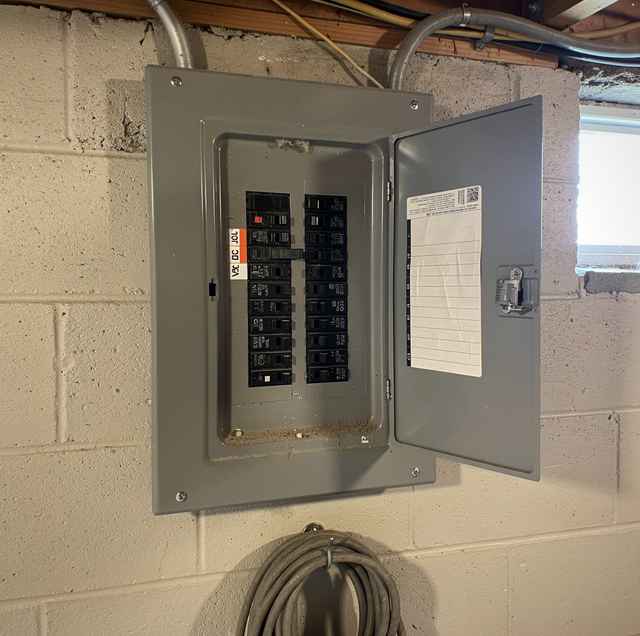
What you will find when you open the panel door depends on how the house was built. A house built in recent decades is, as a rule, copper-wired, with a breaker panel of current design, where an open circuit shows as one handle set apart from the rest of the row. An older house or a manufactured home often still has a fuse box instead, or a breaker panel sized for a smaller electrical load than the household now demands. That difference decides what you can do next.
With a breaker panel: Open only the outer door; the inner cover that the handles poke through stays on. Look for a handle positioned away from ON, and read the circuit directory on the door to find the room's name. Reset that breaker once by pushing it firmly to OFF and then back to ON. If the breaker opens again, stop there. A circuit that will not hold has a fault somewhere along it, and tracing that fault is an electrician's work. If a breaker in an older or undersized panel opened under ordinary use, tell the electrician even if it now holds; it is one of the things they weigh.
With a fuse box: A fuse does not reset. A blown plug fuse can show a darkened window or a broken metal strip behind its glass, while a cartridge fuse gives no outward sign at all. Looking is as far as you go. Replacing a fuse means matching its rating to the wire it protects, and screw-in plug fuses of different ratings fit the same socket, so a wrong choice goes unnoticed until the wire overheats. That choice, and finding out why the fuse blew, belong to a licensed electrician.
A GFCI on Another Wall Can Feed the Whole Room
If nothing at the panel has opened, go back to the shape of the dark area. Lights still burning over a row of dead outlets is the signature of a tripped GFCI device, because a GFCI cuts only the receptacles wired after it and leaves a lighting run on its own path alone. The device doing the cutting can sit in a bathroom that shares a wall with the room in older wiring, on a garage wall behind it, or in the weatherproof outlet on the outside of that same wall. Press RESET once, firmly, on any GFCI whose button has popped.
Look closely at the faces of the dead outlets. A small sticker reading GFCI Protected Outlet means a GFCI elsewhere on the circuit feeds that receptacle, so the RESET button you need sits upstream on some other wall of the house.
A GFCI breaker changes the picture. It carries a small TEST button on the breaker body and protects the entire circuit from the panel. When it trips, the lights on that circuit go dark, along with the outlets, and the room reads as fully dead. It resets at the panel the same way as any other breaker, once. If a GFCI trips again right away, or no GFCI you can find seems tied to the room, leave it there; matching protected outlets to the device that protects them takes an electrician with test equipment.
A Failed Connection Partway Along the Circuit
When the breakers are all on, and every GFCI holds, what remains is a connection that has failed at one of the boxes, since power passes through each box in turn and every box past a broken one loses supply. Here the shape you read at the start does the locating. The last outlet that works and the first one that does not are neighbors along the wire's route, though not always neighbors on the wall, so the break sits at one of those two boxes or in the cable between them. A dead run that begins partway along a wall puts that pair inside the room. A room that is dead from its first box onward, with the panel and every GFCI in order, puts the break before the room, possibly at a box on the far side of a shared wall that still looks normal.
The type of wire in the walls changes how seriously a dead run should be taken. Copper branch circuits, the norm in newer construction, can lose a connection too, and a loose copper termination can heat and arc; aluminum adds a known weakness of its own at exactly these points. Older houses and manufactured homes often have aluminum branch wiring, and aluminum connections at outlets and switches can overheat because the metal expands and contracts at the terminal, forming an oxide where it meets the screw. In an aluminum-wired room, a circuit that went dead without a trip should be treated as a possible hot connection until an electrician has opened the boxes.
Your part here is observation: look for a discolored cover plate and pay attention to any smell. Everything past that, including removing a cover plate or pulling a device from the wall, is the electrician's work, because the conductors inside a box can remain live from another circuit even when the outlet on the face is dead.
A brown or scorched cover plate, crackling, or a hot-plastic smell at any device in the dark room means a connection may be overheating inside the box. Stop resetting anything, leave that device alone, and have a licensed electrician open it.
Switched Outlets and Fixtures Explain Partial Darkness
Sometimes the room has not lost power at all. A room built without a ceiling light can have one outlet, or the top half of one, run from the switch by the door so a lamp comes on as you walk in, and with that switch off the room looks dead from the doorway. Flip each switch in the room and watch the lamp; if one brings it on, nothing is broken.
The same logic runs the other way for a ceiling fixture. When the outlets all work and only the overhead light or fan is dark, the problem is confined to the switch, the fixture, or the short run between them, and that small loop can be on a different circuit from the outlets. A switch that clicks without doing anything can mean the switch itself has worn out. Replacing a switch or opening a fixture box is an electrician's job, for the same reason as any other box: what feeds it may still be live.
What to Tell the Electrician When You Call
A dead circuit gives no outward sign of where it broke, so what you noticed before the call is where the electrician's search begins. Write down which lights and outlets are out, which still work, and whether anything in a neighboring room went with them. Note whether a breaker had opened and whether it held after your one reset, whether any GFCI would latch, and what was running when the room went dark. If you know the house has a fuse box, an older panel, or aluminum wiring, say so, and mention any warmth, discoloration, or smell you saw near a device.
A note that reads "no breaker open, bathroom GFCI reset with no change, wall switch does nothing, outlets on the bed wall dead, ceiling fan fine" has already ruled out three of the four causes above and points the visit straight at the connections along that circuit.
Frequently Asked Questions
It can. A standard home service arrives as two 120-volt legs that together supply 240 volts, and each branch circuit is fed from one leg or the other. If one leg drops due to a failed utility connection or a loose service conductor, the circuits on that leg go dark while the rest keep working, and 240-volt equipment such as the air conditioner or an electric dryer may stop or hum without running. That pattern calls for the utility and an electrician; resetting breakers inside the house will not restore those circuits.
For a lamp or a phone charger, yes, as long as the amperage or wattage rating printed on the cord's tag or jacket matches what you plug into it. Keep the cord out from under rugs and out of doorways, where the jacket gets crushed, and heat has nowhere to go. Do not use an extension cord for a space heater; plug a heater directly into a wall outlet.
A closed refrigerator keeps food safe for about 4 hours without power. A full freezer holds its temperature for about 48 hours, and a half-full one for about 24, as long as the door stays shut. Perishable food that has sat above 40 degrees Fahrenheit for more than 2 hours should be thrown out.
It can. Power strips and surge protectors can have their own on-off switch and a small built-in breaker with a reset button; when that breaker opens, everything plugged into the strip goes dark. If every dead item in the room runs through one strip, look at its switch and reset button before you assume the wall has lost power.
Single-strand aluminum branch wiring was used in US homes between about 1965 and 1973. The cable jacket from that period may be stamped "AL" or "ALUMINUM," which an electrician can read at the panel. Knowing the answer before a room goes dark tells the electrician which connectors and repair methods to bring.
A GFCI requires power at its input terminals before the RESET button will latch, so an open breaker or a failed connection upstream of it prevents the button from holding. GFCI outlets made in recent years also check themselves and refuse to reset once their protection has failed, and some show a red or flashing light on the face when that happens. Pressing it again changes nothing; if the panel shows nothing tripped, the next call is to an electrician.
Trace a dark room back to its fault — a licensed electrician can find where the circuit broke and repair it safely. Kennedy Electric serves Citrus, Hernando, and Pasco Counties. License #EC13011268. Call (352) 251-2795.
