


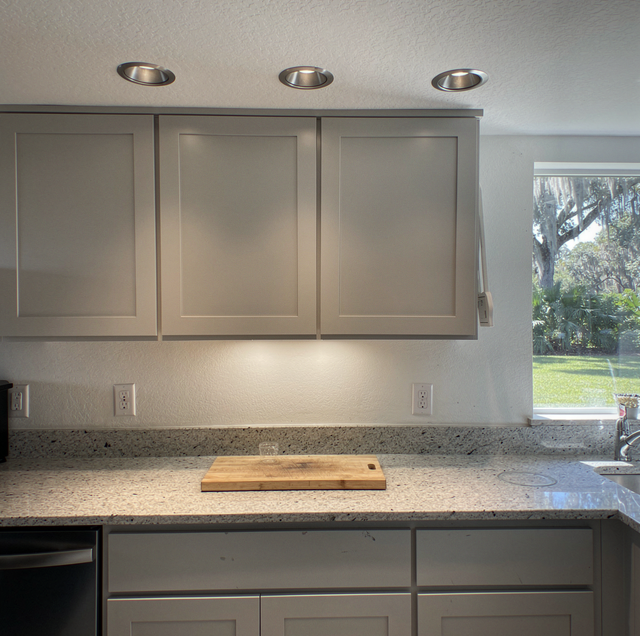
Recessed lighting and track lighting both hang their light from the ceiling, but they get there in opposite ways. A recessed fixture sits within the ceiling plane at a fixed point, and each one needs its own opening, housing either a metal housing (the can) or a slim, canless wafer with a small junction box beside it. Track lighting stays on the surface: a single rail is fastened to the ceiling and fed from one electrical box, and the heads clipped into it slide along the rail and swivel to aim. Two questions decide between them. The first is what the room needs the light to do, whether that means spreading evenly across the floor, landing on a counter, or highlighting one wall. The second is what the ceiling allows: how much depth sits above the drywall, whether insulation fills that space, whether the ceiling slopes, and whether anyone can reach the cavity from an attic.
Matching Each Room to a Fixture Type
Room purpose and ceiling construction pull in different directions in some spaces. Each row here pairs one room or ceiling condition with the option that suits it and the reason it wins there.
| Room or situation | Fits | Reason |
|---|---|---|
| Kitchen work areas | Recessed, set over the front edge of the counters | Light lands on the cutting surface ahead of you, and flush trims stay clear of cabinet doors |
| Living room | Either; track where the layout changes | Cans give even light across the floor, while a head can be re-aimed when seating or a feature wall moves |
| Hallway | Recessed | A flush fixture keeps the passage clear, and a line of openings can follow the hall's length |
| Bathroom and shower area | Recessed with a wet-location trim over the shower | Track stays out of the spray zone, and belongs in the room only where its label allows damp use |
| Home office | Either, placed around the screen | A bright source reflected in a monitor causes glare; heads aimed at a wall bounce light onto the desk |
| Wall with art or shelving | Track, or adjustable recessed trims | Heads slide and re-aim when pieces are rehung, or shelves are rearranged |
| Low ceiling | Recessed, canless where depth is short | Nothing hangs into headroom, and a wafer needs very little cavity depth |
| Sloped or vaulted ceiling | Track, or housings made for a sloped ceiling | The rail follows the pitch while heads swivel to point down; a standard can on a slope throws light at an angle |
| No attic access above | Track | The whole rail runs from a single feed point, so the finished ceiling is not opened at every light |
How Each One Goes Into the Ceiling
Either installation begins at the panel. The electrician switches off the circuit and confirms it is dead before touching a box or cutting drywall, and from there the two jobs split.
For recessed lighting, each fixture location requires a round hole cut in the ceiling, and the location must clear the joists. Ceiling joists run in one direction across a room, so a planned grid of lights either lands between them or shifts to fit. A new-construction housing nails to the joists before the drywall goes up. A remodel housing slides up through the hole and clamps to the drywall from above with spring clips. Canless wafers skip the housing entirely: the thin fixture snaps into the opening, and its wiring connects inside a small junction box that rests on the back of the drywall.
Cable then runs from light to light through the joist bays. A run parallel to the joists is the simpler path. Crossing them means drilling through each joist, which takes access from above, a long flexible bit worked through the fixture openings, or extra openings that are patched and painted afterward.
Track installation concentrates the wiring at one point. The rail's power feed connects at an existing or new ceiling box, through either an end feed at one end of the rail or a canopy feed that can land partway along its length. The rail is then screwed to the ceiling, into the framing where it crosses joists, with drywall anchors between them. No other light openings are needed once the feed box is in place, which is why track suits a plaster ceiling, a concrete deck, or a room with a finished floor directly above it.
Insulation Contact and Housing Ratings
Housings are rated either IC, for direct insulation contact, or non-IC, which needs a clear gap; the rating on the label governs what may touch the can, whatever lamp is inside.
Canless wafers carry their own contact rating on the fixture label, and a wafer listed for insulation contact can sit beneath a blanket of attic insulation. Track sidesteps the question, since nothing enters the cavity except the feed at the box.
A recessed trim or track head that smells scorched, shows browned or melted plastic, or flickers with a buzz signals heat at a connection that can burn skin or ignite framing; that fixture stays switched off until an electrician de-energizes the circuit.
Aiming, Flexibility, and Glare
Once a recessed opening is cut, its location is permanent. A standard trim sends light straight down in a fixed cone. A gimbal or eyeball trim tilts within the opening to direct light toward a wall, and a wall-wash trim spreads light across a vertical surface at a set distance. Moving a recessed light to a new spot means a new hole and a patch where the old one was.
Track treats position as temporary. Heads lock into the rail anywhere along its length, rotate around it and tilt on their own stems, so a head can slide along to follow a painting that was rehung. Heads can be added later, up to the load the track and the circuit are rated to carry.
Glare comes from seeing the bright source itself. A recessed fixture with its light source set back inside a deep trim hides that source from anyone not standing beneath it. A track head aimed carelessly can shine straight into the eyes of someone seated across the room, and a row of heads pointed the same way can reflect off a glossy counter, a TV screen, or a dark window at night.
Showers, Bathrooms, and Location Ratings
Every fixture carries a location rating on its label: dry, damp, or wet. A damp-location rating covers fixtures exposed to moisture that condenses on them but not to direct spray, such as a bathroom ceiling away from the tub. A wet-location rating covers a fixture that can take water directly, and it is the rating a light inside a shower enclosure needs.
For recessed lights, the rating belongs to the housing and trim together. Over a shower means a housing paired with a trim listed for wet locations that closes the opening with a gasketed lens. An open trim without that listing does not qualify, even over an identical housing.
Track systems carry their own rating, and a track listed only for dry locations stays out of the bathroom. Where a track's label allows damp use, it can light a vanity wall or a dressing area, kept clear of the shower. Where that line falls in a particular bathroom comes down to the fixture's listing and the local inspector's call.
Combining Both on One Ceiling
A single room can use both, with each doing the job it suits. A kitchen can carry recessed lights over the counters and a short track above an island or an open shelf. The two sets work well on separate switches, so the aimed heads can run on their own in the evening while the cans stay off. Color temperature matters as well: track heads and recessed trims with the same color temperature keep one wall from looking warmer or cooler than the surrounding room.
Planning an Installation Visit
The layout comes first: where each opening or rail goes, checked against the joist direction, ductwork, plumbing vents, and anything else occupying the ceiling cavity. Switching follows, covering which lights share a switch, whether a room with two doorways gets a switch at each doorway, and whether the lights are on a dimmer. For dimming, the dimmer and the fixture or its driver must be rated to work together; noise and heat at the switch are separate problems.
The existing circuit's load is part of the plan too. New lights added to a circuit that already feeds outlets and other rooms must fit within that circuit's capacity; where they do not, a new circuit enters the conversation. Ceiling access closes the list: whether an attic above allows cable to be run from overhead, how much insulation is up there, and which housing ratings follow from it.
An old ceiling box in the center of a room is a ready feed for a track, provided the box is secured to framing and suited to the connection. A box hung loosely from the drywall, or one buried where the rail cannot reach it, turns into part of the job rather than a head start.
Frequently Asked Questions
Not reliably. Track is made in several incompatible connection types, each identified by a letter on the rail's label, and a head built for one will not lock into another. That letter, printed on the label or packaging, has to match any replacement or added head.
Yes, on a two-circuit track. The rail carries two sets of conductors, each fed from its own switch, and each head is set to draw from one circuit or the other. A single-circuit track turns every head on and off together.
A recessed housing can contain a thermal protector, a small switch that opens the circuit when the can overheats and closes again once it cools. That cycling can come from heat buildup, such as insulation packed against a non-IC can, a lamp above the housing's rated wattage or a bulb not rated for an enclosed trim, or from a worn protector that opens early. The light should stay off until an electrician finds which one it is.
Standard housing has gaps and openings that allow room air to move up into the attic, carrying conditioned air with it. An airtight-rated housing, marked IC-AT on some labels, pairs a sealed can with a gasket at the trim to limit that leakage. On a ceiling below an unconditioned attic, that rating is worth specifying.
Yes. An LED retrofit module fits into the existing housing, connecting via a screw-in adapter at the old socket or, on some kits, a plug connector, and is held in place with friction springs or torsion clips. A retrofit kit needs a listing that names it for use in that particular housing.
Yes. Track sections can be cut to length and joined with straight, L, T and X connectors from the same system, so a run can be lengthened, turned at a corner or branched. The whole run, including the extension, can still draw power from its original feed within the track's rated load.
Line up recessed or track lighting installation — fixture layout against the joists, switching and dimmer planning, rated housings and trims, and new ceiling wiring. Kennedy Electric serves Citrus, Hernando, and Pasco Counties. License #EC13011268. Call (352) 251-2795.
