


Ceiling Fan Wobble? Start at the Ceiling, Not the Blades
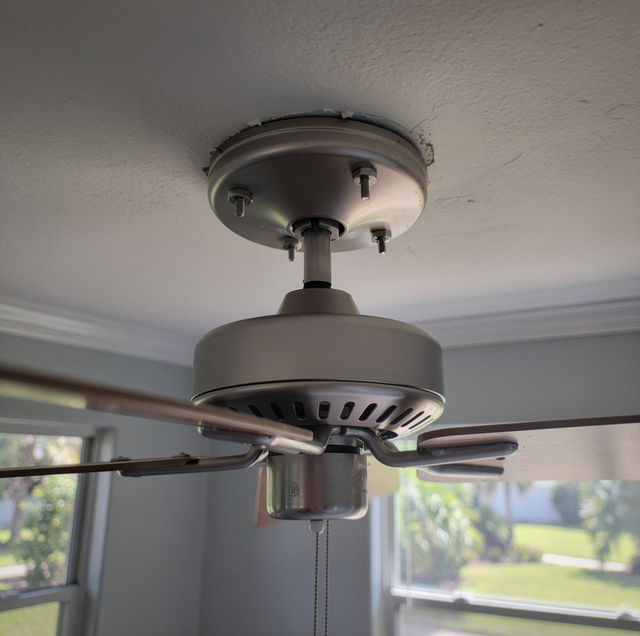
The shadow tells you before your eyes do. A fan on medium throws a slow sweep across the wall; the light kit beneath it traces a small circle, and the blades look as if they are tracing the surface of a cone rather than a flat disc.
A ceiling fan is 15 to 50 pounds of rotating mass hanging from a single point in the ceiling. On high, a 52-inch fan turns near 200 revolutions per minute, which puts the blade tips close to 30 miles per hour. Two things follow. Any mass difference between the blades is multiplied by that speed, and any looseness at the hanging point lets the entire assembly swing as it spins. The second is by far the more common cause, and it lives above the blades rather than among them.
So the search runs downward from the structure: the box in the ceiling, the bracket screwed to it, the downrod and its pin, the ball joint under the canopy, the motor housing, and only then the blades.
The Box It Hangs From Is the Only Real Safety Question
A standard lighting outlet box is built for a static load, a fixture of a few pounds that hangs still for twenty years. Many are thin steel or plastic nailed to a joist through a light bracket, and some are held by nothing more than the drywall around the rim. A fan asks something else of that box: on top of dead weight, it delivers a small side-to-side pull that reverses a few hundred times a minute for every hour the fan runs.
A box listed for ceiling fan support is built for exactly that. It is either fastened directly into framing or carried on an expanding brace bar that spans between two joists and bears on the wood, and it carries a marking inside saying it is acceptable for fan support. The fan's own instructions call for that box, and the listing is what backs up the instructions. Fans have come down from boxes never meant to hold one.
This is the one item here that is not a tighten-it fix. Confirming it means dropping the canopy and reading the marking inside. If there is no marking, if the box is plastic with nothing braced behind it, or if the fan has dropped even slightly at the ceiling, the fan comes down until the support is corrected. That is an electrician's call, not a ladder-and-screwdriver call.
Worth saying plainly: a wobble in a properly supported fan is not a sign the fan is about to fall. The support carries a load that barely changes, while the wobble is a rotational symptom happening below it. It is a comfort and wear problem, not a countdown.
Kill the circuit at the breaker before the canopy comes down. A wall switch opens one conductor, leaving everything else in that box connected, and many fans carry a second switched leg for the light. Work with a second person.
One Measurement Sorts the Top Half From the Bottom
Before anything gets tightened, take one measurement. With the fan stopped, hold a yardstick or tape against the ceiling beside one blade tip and note the distance from ceiling to the top surface of the blade. Then turn the blades by hand until the next blade sits at that same spot in the room, and measure again. Ceilings are rarely flat, so measuring each blade wherever it happens to be parked gives you the ceiling's error rather than the fan's.
If every blade reads within about an eighth of an inch of the others, the blade plane is true, and your problem is above it, in the box, the bracket, the pin, or the ball. If one blade sits a quarter inch high or low while the rest agree, that blade or its holder is the fault, and no amount of balancing weight will correct it. A clip weight changes mass. It cannot change geometry.
Loose Mounting Screws Undo an Otherwise Good Box
Two sets of fasteners live at the ceiling and both back out. The hanger bracket attaches to the box with a pair of machine screws, usually through rubber isolators intended to dampen motor noise, and the box itself attaches to framing or a brace bar. A quarter-turn of slack in either place lets the bracket rock against the box face once per revolution, and the wobble that follows increases sharply between medium and high.
The tell is sound. A mount that is loose at the ceiling often adds a soft tick or knock at the top of the fan, in time with the rotation, that a balance problem never produces. Check those screws with a driver rather than by feel, and never test a mount by pulling down on the fan or leaning on a blade. A fan that has been hung on will read as tight right up until it no longer does.
The Downrod Pin and the Set Screw Do Two Different Jobs
The cross pin through the downrod, with its cotter or retaining clip, carries the weight and keeps the rod from sliding out of the motor coupling. The set screws do something else entirely: they stop the rod rotating inside the coupling against motor torque, and they take the slop out of the fit.
If the rod is not pushed fully home before the pin goes through, the pin bears on the edge of its hole and the rod sits a couple of degrees off vertical. A set screw tightened onto a burr, or landing on the flat of the rod instead of its dimple, leaves the same few degrees of play. Either way the fan tilts as a whole: the blade tips drop evenly toward one side of the room and climb evenly toward the other. One odd blade is a blade problem. A smooth height change all the way around the circle is a rod that is not seated straight.
A few degrees of play at the ball tilts the blade plane by the same few degrees, whatever the rod length, but it swings the whole fan body sideways three times as far on a 36-inch downrod as on a 12-inch one.
The Canopy Covers the Ball Joint, It Does Not Hold It
The canopy is a cosmetic cup that hides the joint that matters. Inside it, a ball at the top of the downrod rests in a seat machined into the hanger bracket, and a notch or slot cut into that ball has to engage a tab or pin in the bracket. The notch prevents the fan body from rotating under motor torque while still allowing it to pivot.
When the ball is resting high in its seat, or when the notch missed the tab during installation, the fan hangs on a joint that can rock a few degrees in any direction. Because the canopy screws to the bracket rather than to the ball, everything looks tight from below while the joint above it is not seated at all. Reseating is a two-person move: take the weight of the motor, lift slightly, rotate until the ball drops fully into the seat and the notch captures the tab, then let it settle and refit the canopy.
A Bent Downrod and a Shifted Motor Housing Read Differently
A rod usually gets bent off the ceiling rather than on it. Fans get lifted by the downrod during installation, carried by it, or stored leaning with weight against them. The resulting wobble is constant. It shows at every speed with roughly the same amplitude, and it does not change when you add or move a balancing weight. With the rod out, roll it across a flat floor and watch the gap under the middle.
The motor housing has its own fasteners. The blade holders bolt to a rotating hub. If the housing screws have loosened or the fan took a knock during a room repaint, the hub itself is tilted, and every blade inherits the error equally. A fan whose light kit also flickers is asking a separate question about the connections feeding it, not about the mount.
Blade Holders and Warped Blades Are Further Down the List
Blade holders are stamped or cast brackets that bolt to the hub with two or three screws, and the blade bolts to the holder with two or three more. Every one of those loosens. A holder can also be bent by a box stacked on it before installation or by someone pushing the fan aside to paint, and a few degrees of bend sets that blade out of the plane the others share.
The blades themselves change. Plywood and pressed-board blades take up moisture, swell, and cup, which alters both weight and pitch. Pitch is the sneaky one. A cupped blade moves a different volume of air than its neighbors, and an unequal air load produces a wobble that appears only when the fan is running and vanishes at rest, even though the fan measures perfectly true when stopped. Blades ship as weight-matched sets for the same reason, so a single replacement blade from a parts bin puts a mismatched mass on one arm. Dust does the cheaper version of the same thing. It lands on the top face and clings unevenly, and a blade under a supply register collects more of it than the one across from it, so wipe them all with the same cloth before measuring.
Timing helps you sort this. A fan that ran true for years began wobbling after a change of season, pointing at the blades. A fan that wobbled from the day it went up is pointing at assembly, most often the ball joint or the downrod.
Balancing Is Last, and It Is Worth Doing Properly
Once the plane measures true and every fastener is tight, a residual wobble really is a small mass difference between blades, and the balancing kit taped inside the carton will fix it. Clip the metal weight to the trailing edge of one blade, about midway out, and run the fan at the speed where the wobble is worst. Work one blade at a time until the wobble drops, then slide the clip along that blade to find the spot where the movement is smallest. The adhesive weight goes on top of the blade at that spot, in line with where the clip sat, and the clip comes off.
Frequently Asked Questions
Boxes listed for fan support are good for up to 35 pounds without any additional markings; above that, the box must be marked with the weight it carries, and a heavy fan with a large light kit can exceed that limit. The listing, not the wobble, is what decides whether a fan is at risk of coming down.
Some tip movement is ordinary, and most fans show it. The scale of the correction tells you more than the movement does. Balancing weights are only a few grams each, and a kit ships with three to five of them, so a fan that swallows the entire kit without settling down does not have a balance problem at all.
Speed-dependent wobble that peaks at a middle setting and calms down above it usually means the fan is exciting a resonance in the ceiling structure at that frequency. Joist span, subfloor stiffness, and whether the box sits mid-span or near a bearing wall all move that frequency.
Most likely, the blades absorbed moisture. Manufacturers finish the visible face of a blade and often leave the top face bare, so the two sides absorb at different rates and the blade cups toward the unfinished side. The change is reversible on some blades and permanent on others, and it shows on wood and pressed board long before plastic.
Rarely. Nearly everything on the list gets done from a ladder with the fan hanging. Many hanger brackets include a hook or keyhole slot that supports the motor's weight when the ball is unseated, which keeps the work on the ladder rather than on the floor. Only a box replacement or a bent downrod actually requires the fan to be removed from the ceiling.
It can. A glass shade tightened unevenly, a missing shade in a set, or a light-kit collar whose set screws have backed off puts the mass off-center below the motor and produces a slow circular sway that follows the light rather than the blades.
Have the fan's support box and mount inspected — a licensed electrician can confirm the box is listed for fan support, correct the mount and ball joint, and tell you whether what remains is a balance issue or a support problem. Kennedy Electric serves Citrus, Hernando, and Pasco Counties. License #EC13011268. Call (352) 251-2795.
