

When to Replace vs. Repair Electrical Appliances
That oven didn’t just “have a bad day.” It has been acting weird for months, tripping breakers, buzzing louder than it should, and now you are standing in the kitchen wondering if you are about to waste money fixing something that is already on borrowed time. Plenty of Florida homeowners end up frustrated right here, stuck between another repair bill and the fear of replacing an appliance that might still limp along for a bit longer.
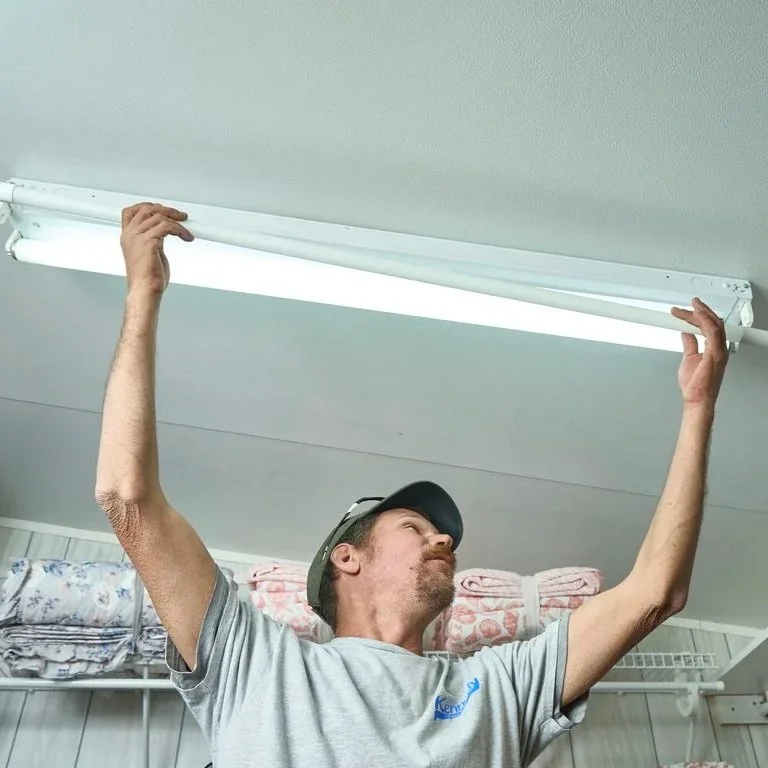
Electrician replacing ceiling light fixture while homeowners evaluate appliance performance, energy efficiency, and whether repairs still make financial sense.
Living With Appliances That Are Quietly Driving You Nuts
Most homeowners do not wake up one morning and decide to research when to replace vs. repair electrical appliances. The search usually starts after weeks or months of small, annoying problems that pile up. A refrigerator that hums louder every night, a dryer that takes two cycles instead of one, or a dishwasher that leaves dishes lukewarm and questionable no matter which setting you choose. Those issues slowly chip away at daily routines, raise electric bills, and create that low-grade frustration that makes people mutter under their breath as they flip breakers or reset control panels.
In Florida homes, appliance stress often gets worse because heat and humidity push electrical components harder than many people realize. Compressors run longer, motors cycle more frequently, and control boards live in warm, sometimes poorly ventilated spaces. Homeowners often assume appliances are built to handle these conditions indefinitely, but wear shows up faster here. That misunderstanding leads people to keep repairing machines that are already past their practical lifespan, understanding too late that each repair only delays an inevitable replacement while costs quietly add up.
The Real Cost Question Most People Get Backwards
When homeowners consider whether to repair or replace an appliance, the decision often comes down to the immediate cost. If a repair quote is cheaper than buying new, the fix feels like the responsible choice. That logic makes sense on the surface, but it ignores how electrical appliances actually age and how repair costs compound over time. A single repair rarely happens in isolation once an appliance reaches a certain point.
Electrical appliances tend to fail in clusters. A failed heating element or worn motor brushes can signal that wiring insulation, control boards, or internal sensors are not far behind. Paying for repeated service visits, diagnostic fees, and replacement parts can quietly approach or exceed the cost of a new appliance within a year or two. Florida homeowners are often surprised when utility bills creep higher after repairs, because older appliances lose efficiency even when individual parts get replaced. That ongoing energy waste becomes part of the real cost that never shows up on a repair invoice.
Age Is Not Just a Number With Electrical Appliances
One of the most common homeowner mistakes involves appliance age. People hear general rules like ten years for a refrigerator or fifteen years for a range and treat them as hard deadlines. Others assume an appliance that “still turns on” must have plenty of life left. Both assumptions fail to account for how age interacts with usage, environment, and electrical stress in a Florida home.
An appliance that is eight years old but has lived through constant heat, power fluctuations, and heavy daily use may be closer to end-of-life than a fifteen-year-old unit in a cooler, lightly used home. Internal wiring becomes brittle, solder joints weaken, and control boards become more sensitive to voltage changes. Those issues rarely announce themselves clearly. Instead, homeowners see intermittent problems that seem random, making it tempting to chase repairs without stepping back to evaluate the bigger picture.
When Repair Still Makes Sense And Why
Repairing an electrical appliance can absolutely be the right call under the right conditions. Newer appliances with isolated failures often respond well to targeted repairs. A failed door switch, worn belt, or faulty sensor does not automatically mean the entire unit is on its way out. When the core electrical systems remain healthy and parts are readily available, a repair can restore reliable function without long-term regret.
The key factor many homeowners overlook is repair history. A first major repair on a relatively young appliance carries a very different risk than the third or fourth repair on a machine that has already shown signs of systemic wear. Electricians often see homeowners approve a repair because it “worked last time,” without realizing each successful fix may simply be buying shorter and shorter stretches of functionality. Understanding when a repair addresses a root issue versus a symptom makes all the difference.
Why Electrical Problems Rarely Stay Isolated
Electrical appliances are systems, not collections of independent parts. When one component fails, it often stresses others. A failing motor can overload wiring. A damaged heating element can strain control boards. A loose connection can cause arcing that slowly damages surrounding components. Homeowners frequently underestimate how interconnected these failures are, especially when appliances still appear mostly functional.
Ignoring that system-level reality leads to a common cycle. A repair restores basic operation, confidence returns, and months later, a different part fails. Over time, appliances become less predictable, breakers trip more often, and safety risks increase. In Florida homes where moisture and heat accelerate corrosion and insulation breakdown, those risks rise faster. Electrical smells, flickering displays, or unusually warm appliance surfaces should never be dismissed as quirks.
The Hidden Safety Angle Many People Miss
When homeowners weigh repair versus replacement, safety rarely gets the attention it deserves. Electrical appliances that operate outside their intended tolerances can become fire hazards long before they fully fail. Aging wiring, compromised insulation, and overheating components do not always trigger obvious alarms. Instead, they quietly increase risk behind panels and covers that homeowners never see.
Electricians often encounter appliances that have been repaired multiple times but still draw irregular current or generate excessive heat. Those conditions may not prevent the appliance from running, but they can cause stress on household electrical systems. In Florida, where many homes already run close to capacity due to air conditioning loads, that extra stress matters. Replacing an appliance at the right time can reduce not only frustration but also long-term electrical risk that repairs cannot fully eliminate.
Why Newer Appliances Are Not Always the Easy Answer
Some homeowners swing too far in the opposite direction and assume replacement is always smarter. New appliances promise efficiency, quieter operation, and modern features, but replacement brings its own set of considerations. Not every home electrical system is immediately ready to support newer appliances without upgrades. Increased power demands, sensitive electronics, and different grounding requirements can turn a simple swap into a more complex project.
Florida homes built decades ago may lack the dedicated circuits or panel capacity that modern appliances expect. Installing a new unit without addressing those underlying electrical limitations can lead to nuisance tripping, shortened appliance lifespan, or performance issues that feel just as frustrating as the old machine. Understanding that replacement may also require an electrical evaluation helps homeowners avoid disappointment and unexpected costs.
The “It Still Works” Trap
One of the most common phrases electricians hear is “it still works, so I figured I’d keep it.” That mindset makes sense emotionally, especially when appliances represent significant investments. The problem lies in how people define “works.” An appliance that technically operates but performs poorly, consumes excess energy, or behaves unpredictably creates an ongoing inconvenience that homeowners come to normalize over time.
Dryers that require multiple cycles, refrigerators that struggle to maintain temperature, and ranges with inconsistent heating all technically work. They also waste electricity, strain internal components, and create daily friction that homeowners tolerate until a final failure forces an urgent decision. Planning replacement before that breaking point often costs less and restores peace of mind far sooner than riding an appliance until it quits entirely.
Florida-Specific Wear You Cannot Ignore
Climate plays a bigger role in appliance longevity than many homeowners realize. Florida heat increases run times, humidity affects insulation and contacts, and salt air in coastal areas accelerates corrosion. Those factors shorten the effective lifespan of electrical appliances compared to national averages often quoted online.
Homeowners searching for when to replace vs. repair electrical appliances in Florida should adjust their expectations accordingly. Waiting for appliances to reach textbook lifespans can backfire. Electricians regularly see appliances that fail earlier here despite good maintenance. Factoring local conditions into replacement timing helps avoid emergency breakdowns that disrupt daily life and limit replacement options.
How Electricians Actually Evaluate the Decision
A professional evaluation looks beyond the immediate fault. Electricians assess electrical load, component condition, wiring integrity, and overall system compatibility. That broader perspective reveals whether a repair extends the appliance’s remaining life or merely postpones a more serious failure.
At Kennedy Electric, conversations with homeowners often focus on patterns rather than single events. Repeated breaker trips, rising energy usage, or multiple appliance issues in one area of the home suggest underlying electrical stress. In those cases, replacing one appliance without understanding the bigger picture can lead to frustration when problems continue elsewhere.
Timing Matters More Than People Think
Appliance decisions made under pressure tend to cost more. Emergency replacements limit choices, rush installations, and often happen at the worst possible moment. Planning replacement based on condition rather than failure gives homeowners control. Scheduling evaluations, budgeting realistically, and coordinating any needed electrical upgrades turn a stressful event into a manageable project.
Seasonal timing also matters. Florida summers push appliances hardest, especially refrigerators and air-related equipment. Addressing marginal appliances before peak demand reduces the chance of mid-season failures that disrupt daily routines and increase discomfort. Timing replacement thoughtfully often pays off in reliability and peace of mind.
FAQs
Repeated issues, increasing repair frequency, and declining performance usually signal that repairs are no longer addressing the root problem. If an appliance has needed multiple electrical repairs within a short period, replacement often becomes the more stable long-term choice.
Minor issues can escalate over time, especially when heat and electrical load remain constant. Unusual smells, warmth, or flickering displays indicate underlying problems that can increase fire risk if ignored.
Newer appliances generally operate more efficiently, but actual savings depend on usage patterns and electrical compatibility. Upgrading without addressing electrical system limitations can reduce expected efficiency gains.
Yes, inadequate circuits, outdated panels, or inconsistent voltage can shorten appliance life. Electrical evaluations often reveal system factors that contribute to premature appliance failure.
Electrical symptoms such as breaker trips, power fluctuations, or multiple appliance issues point to broader electrical concerns. An electrician can assess whether the problem extends beyond the appliance itself.
