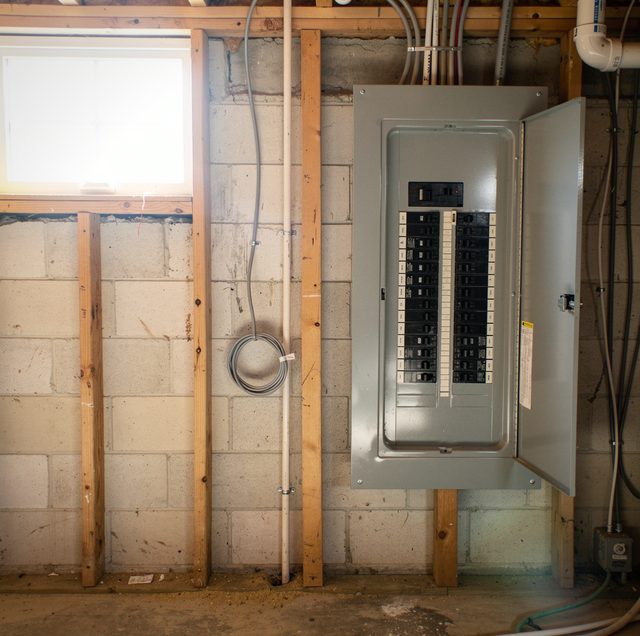
A subpanel is a second breaker panel, fed by a feeder that runs from a breaker in the main panel to lugs inside the subpanel. It holds its own breakers, but it is not where the house's neutral and grounding systems are tied together. That connection is made once, at the main panel or at the service disconnect ahead of it, so inside a subpanel the neutral conductors and the equipment grounds land on two separate bars. A subpanel can power every circuit it serves and still send current where it should not travel, and the evidence turns up at the lights, fixtures, and appliances it feeds.
Each sign at those circuits is set against the wiring error it can signal and the reason that error matters.
| Sign at the circuits | Wiring error it can signal | Why it matters |
|---|---|---|
| A mild tingle from a metal appliance, fixture, or faucet on a subpanel circuit | Neutral and ground joined at the subpanel | Return current rides on ground wires and on metal that people touch |
| Lights on subpanel circuits that brighten and dim as large loads start | A loose or missing feeder neutral | Voltage divides unevenly between the two halves of the subpanel |
| The main-panel breaker that feeds the subpanel tripping or running warm | A feeder breaker and feeder wire that do not match, or a loose termination at that breaker | One mismatch trips under ordinary load; the other lets the wire heat past its rating |
| Buzzing, scorch marks, or a hot odor at the subpanel | Loose or overheated lugs and terminations | Heat at a poor connection chars insulation and damages lugs and bars |
| Lights in a detached building's subpanel that act up in wet weather | A feeder to the outbuilding without a separate grounding path | Return and fault current lean on the neutral and on earth contact that shifts with moisture |
| More than one wire under a single breaker screw | A double-tapped breaker not marked for two wires | One of the two wires can sit loosely held and heat at the screw |
Neutral and Ground at a Subpanel
Current leaves on a hot conductor and returns on the neutral. The equipment ground runs alongside, carries no current in normal operation, and exists for faults: when a hot wire touches a metal box or an appliance frame, current rushes down the ground wire to the main panel, and because neutral and ground are joined there, that fault current has a direct route back toward the utility's neutral and trips the breaker.
Join neutral and ground a second time, at the subpanel, and the ground wire stops being a standby path. Normal return current splits between the neutral and every metal path tied to ground downstream of the main panel: the feeder's equipment ground, the subpanel enclosure, metal boxes, metal conduit, and bonded metal piping. Current divides among parallel paths in proportion to how easily each one carries it, so a share of it travels on metal that people touch. Where a path has resistance, that current leaves a small voltage on the metal, and someone touching a metal appliance with one hand and a faucet with the other can feel it as a mild tingle.
Panels are built so the neutral bar can be bonded to the enclosure with a green screw or a metal strap, which is correct in a main panel. In a subpanel, that bond is left out, and the neutral bar sits on insulators, isolated from the box. A bonding screw or strap left installed, neutrals and grounds landed together on one bar, or a feeder run with no equipment ground at all, so the neutral was pressed into service as the ground, all produce the same condition. A tingle from an appliance, fixture, or faucet takes that item out of service until an electrician has checked the subpanel.
The Feeder and Its Neutral
A subpanel's feeder brings two hot conductors, one from each leg of the service, along with the neutral and the equipment ground. The 120-volt circuits are split between the two legs, and the feeder neutral carries the difference between the two legs' currents back to the main panel.
If that neutral loosens at either end or breaks, the 120-volt circuits on the two legs end up in series across 240 volts, and the voltage divides by the load. The leg carrying the heavier load sags, and the leg carrying the lighter load climbs. When a large 120-volt load starts on one side, lights on that side dim and lights on the opposite side brighten together. Flicker across a whole house has a wider set of causes; an opposite swing confined to circuits fed by the subpanel puts the feeder neutral under suspicion.
The two errors compound. Where neutral and ground are also joined at the subpanel, a failing feeder neutral pushes return current onto the ground wire and every metal path tied to it, which can mask the flicker while raising the voltage on metal parts.
A written note of which lights brighten, which dim, and which appliance was starting at that moment gives the electrician a leg-by-leg picture of a feeder-neutral fault before the subpanel cover comes off.
Matching the Feeder Breaker to the Feeder Wire
The main-panel breaker that feeds the subpanel is there to protect the feeder conductors. It trips on the heat and magnetic force produced by the current, and its rating is set at or below the current the wire can carry without overheating. A breaker rated higher than its conductors allows the wire to carry more current than it was built for: the insulation warms along the entire run and at every termination while the breaker stays closed.
The opposite mismatch, a breaker rated below what the subpanel's loads draw, trips under ordinary use. Conductor material adds a wrinkle, since aluminum and copper of the same size carry different amounts of current, so a breaker chosen as if an aluminum feeder were copper protects the wire at the wrong level. A feeder breaker that trips or runs warm fits either mismatch, and a larger breaker fitted on guesswork can leave the wire unprotected.
Connections, Lugs and Double Taps
Every conductor in a subpanel ends at a termination, from the feeder's main lugs to the screws on the breakers and bars, each tightened to a torque value when it is made. A termination left loose, or one that works loose as metal heats and cools under load, adds resistance at a single point, and current through resistance makes heat right there. Heat oxidizes the contact surfaces, the oxide adds resistance, and the connection runs hotter with each cycle. Aluminum grows an oxide skin wherever bare metal meets air, so conductor preparation and lug tightening carry extra weight on an aluminum feeder.
The signs are an odor of hot plastic or scorching around the subpanel, a cover that feels warm or looks discolored, browning at the edge of a breaker, and buzzing or crackling. Any of these means staying away from the panel and calling.
A second wire clamped under a breaker screw made for one is a related termination fault; the second wire needs a terminal of its own.
Subpanels in Detached Buildings
A subpanel in a detached garage, shop, or barn sits at the end of a feeder that crosses open ground, in a building with its own contact with the earth; whether a home needs one, and how its feeder is sized, are separate capacity questions. The error that produces symptoms out there is a feeder with two hots and a neutral, but no separate grounding path, with neutral and ground joined at the outbuilding panel. That arrangement relies on a single conductor to carry both return and fault current simultaneously. If that neutral corrodes at a buried splice or loosens at a lug, return current looks for another way back, through the earth and through metal running between the buildings, such as a metal water line. Earth contact changes with moisture, so outbuilding lights that dim or swing brighter when the ground is wet, and hold steady when it is dry, fit that pattern. A feeder with a separate grounding path keeps the neutral isolated at the outbuilding panel, just like any subpanel inside the house.
What Correcting a Subpanel Involves
The correction follows the error. Where neutral and ground are joined at the subpanel, the bonding screw or strap is removed, neutrals and grounds are separated onto their own bars, the neutral bar is confirmed to be isolated from the enclosure, and a bonded ground bar is added if the panel lacks one. A feeder with no grounding path gets one, which can mean pulling a new conductor or replacing the feeder.
A loose feeder neutral is re-terminated, or the feeder is replaced where the conductor is burned, corroded, or badly spliced. A mismatched feeder breaker gives way to one rated for the wire, or the wire is upgraded to suit the load. A scorched lug, melted breaker, or pitted bar is replaced, and damage spread across the bus can call for a new subpanel.
The homeowner's part stays outside the cover: stop using an appliance or fixture that tingles, keep away from a subpanel that smells hot, looks discolored or buzzes, and leave a tripping feeder breaker at its existing rating.
A subpanel's feeder lugs remain energized from the main panel even when every breaker in the subpanel is switched off, and contact with them can cause a fatal electric shock or an arc burn. A licensed electrician handles any work behind that cover.
Whether the correction needs a permit and an inspection is decided by the local authority and its inspector.
Frequently Asked Questions
With a clamp meter around the feeder's equipment ground wire while the subpanel's circuits run. On a correctly wired subpanel, that wire carries no current, and the meter reads close to zero. A reading that rises and falls with the load indicates that the return current has found a second path.
A 240-volt-only load, a water heater element or a 240-volt well pump motor on its own double-pole breaker, for example, connects hot to hot and never uses the neutral. It sees the full voltage between the two legs whether the neutral is sound or not, so it keeps working while the 120-volt circuits beside it misbehave.
No. A subpanel inside the house is grounded through the equipment ground in its feeder, which runs back to the main panel where the grounding system meets the earth. A rod driven at the subpanel cannot stand in for that conductor: soil carries fault current poorly, so a fault routed through the earth can fail to draw enough current to trip the breaker. A driven rod belongs at a separate building, in addition to the feeder's ground.
Yes. A GFCI breaker compares the current leaving on its hot conductor with the current returning through its own neutral connection. If that circuit's neutral is connected to the subpanel's neutral bar or ground bar instead of the breaker's neutral terminal, the return current bypasses the breaker's sensor, and the breaker trips as soon as a load runs. A neutral touching a ground wire anywhere along a GFCI-protected circuit trips it the same way.
It can. A feeder run in metal conduit whose fittings and couplings form a continuous electrical path can use that conduit as its equipment ground, so a subpanel fed that way may have no green or bare ground wire in the feeder and still be grounded. Any one joint can break that path, whether a loose set-screw coupling, a corroded fitting, or a length of plastic conduit spliced into the run, and the subpanel then loses its fault path.
No. Each neutral has its own terminal on the bar, so loosening one screw while working on a single circuit leaves every other circuit's return connection intact. Ground wires are handled differently: some bars are marked to accept more than one ground wire under a terminal, and those can share where the marking allows it.
Set up subpanel repair and correction — separation of the neutral and ground bars, re-terminated or replaced feeder conductors, and a feeder breaker matched to its wire. Kennedy Electric serves Citrus, Hernando, and Pasco Counties. License #EC13011268. Call (352) 251-2795.