


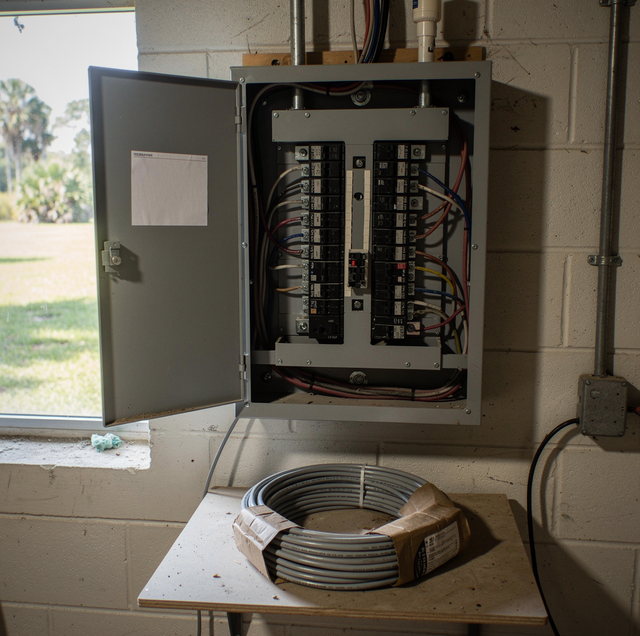
A tandem breaker is two single-pole breakers built into a single housing, the width of a single standard breaker, so one space in the panel carries two separate circuits. When every slot in a panel is taken, and one more circuit is needed for a garage outlet, a new light, or an added room, that doubling looks like free room. Sometimes it is exactly that. Other times the panel was never built to take a tandem in the open position, the panel has already reached the number of circuits it is built for, or the shortage was never about slots in the first place. Standard breakers and tandems line up on these points of difference:
| Point of difference | Standard single-pole breaker | Tandem breaker |
|---|---|---|
| Space used | One full space | One full space |
| Circuits per space | One | Two, each with its own handle |
| Where the panel allows it | Any space, if the breaker type is one the panel's label names | Only positions the label marks for tandems, and only up to the label's circuit total |
| Connection to the bus | One clip on one stab | Both circuits clip to the same stab, so both ride the same leg of the service |
| What it does not solve | A panel with no open space | A service that is out of amps, or a panel already at its circuit total |
How a Tandem Breaker Works
A standard single-pole breaker has one handle, one trip mechanism, and one terminal screw. It clips onto one stab of the bus bar, draws power from that stab, and sends it out on the single circuit wire secured under its screw. When the current on that wire exceeds the breaker's rating, the mechanism opens, and the circuit goes dead.
A tandem splits that same footprint in half. Inside the housing sit two complete single-pole breakers side by side, each with its own handle, trip mechanism, and terminal. Both halves draw from the one stab the housing clips onto. From the circuit's point of view, nothing changes: a 20-amp pole in a tandem protects its wire at 20 amps, the same as a 20-amp standard breaker would.
The detail that matters is the shared stab. A residential panel alternates its stabs between the two legs of the incoming service, so two standard breakers sitting one above the other land on opposite legs. The two halves of a tandem cannot do that. Both circuits end up on the same leg, and that one fact decides where a tandem is harmless and where it causes trouble.
On some panel lines, the same result comes from half-width breakers, two to a space. The logic below applies to those as well: the panel's label, not the breaker's shape, sets the limit.
Why a Panel Only Takes Tandems in Certain Positions
A breaker that clips onto a bus is not the same thing as a breaker the panel's listing covers. Every panel carries a label, printed by its maker, that names the breaker types the panel is listed for, gives the number of spaces, and gives the total number of circuits the panel may carry. Where those two numbers match, the panel takes no tandems at all. Where the circuit number is higher, the label's diagram shows which positions can hold tandems.
Those positions are built differently at the bus. On panels designed with a circuit limit, a tandem made for that panel line has a clip shaped to seat only on the stabs built to receive it. Pressed onto any other stab, it will not seat properly. That shape is what keeps a full panel from quietly growing past the circuit total its bus and enclosure were rated for.
The label and the panel's listing, read together with the local inspector's view, decide what goes where. A tandem of the right type in a marked position fits the panel's design. A tandem forced into an unmarked position, or a breaker of a type the label does not name, falls outside it, even when the handle lines up and the circuit works.
A phone photo of the panel label, taken with the door open and the breakers left alone, plus a second photo of the breaker rows, lets an electrician check the marked tandem positions and the circuit total before the visit.
When a Tandem Is a Reasonable Fix
A tandem earns its place when three conditions hold at once. The panel's label marks open tandem positions; the count of circuits already installed is below the label's total; and a load calculation shows the service has headroom for the added circuit.
With all three true, a tandem is a clean way to add one or two light 120-volt circuits: a dedicated circuit for a garage door opener, a lighting circuit for a new fixture run, or a receptacle circuit in a room that ran out of outlets. Converting a standard single-pole breaker in a marked position to a tandem frees one circuit without moving any other breaker or adding a box to the wall.
A tandem also makes sense when the circuits it will carry are independent of each other. Two circuits that each have their own neutral wire can share one tandem without the shared-neutral problem described below.
Where a Tandem Creates a New Problem
The shared stab turns into a hazard with a multiwire branch circuit. That design runs two hot wires from opposite legs of the service and brings both back on one shared neutral. Because the legs are opposite, the neutral carries only the difference between the two currents. Land both hots on the two halves of one tandem, and they share a leg, so the neutral now carries the sum. That neutral has no breaker of its own, and it can run past its rating with nothing in the panel set to stop it.
Leg balance is the second concern. Moving several circuits onto tandems that all sit on one leg can load that leg while the other runs light. An electrician looks at where each tandem lands so heavy circuits stay spread across both legs.
A buzz or crackle from a newly added tandem can come from a poor connection at the stab, a loose terminal, or a faulty breaker, and each of those is panel repair work for an electrician.
When a Full Panel Needs a Subpanel or Panel Upgrade Instead
A tandem adds circuits inside the box; it adds no amps to the service feeding the box. If the main breaker shuts the house down during heavy use, or a load calculation puts the home at or near its service rating, a tandem only puts another draw on a service that has no room for it. That case calls for a larger service.
Other signs turn the choice away from a tandem even when capacity is fine:
- Circuit total reached: Once the installed circuits equal the label's total, the panel has no room left under its rating for another tandem, whatever the slots look like.
- No marked positions open: A panel whose tandem positions are all used, or whose label allows none, cannot take another tandem anywhere.
- Several circuits planned at once: An EV charger, a workshop, or a new room adds a cluster of circuits. A subpanel near the new load, fed from the main panel, provides those circuits with their own space.
- Panel condition: Scorched stabs, a discolored bus, or a panel line for which listed breakers are no longer made turn the question from adding a breaker to replacing the panel.
Repeated tripping on a single circuit is its own diagnosis, separate from a shortage of space. Moving that circuit onto a tandem changes nothing about the fault behind the trip.
What an Electrician Checks Before Adding Either
Fitting any breaker means removing the panel's cover and working inside a box where the incoming utility wires and the lugs they connect to remain live after the main is switched off, so the work must be done by a licensed electrician from the first step. The check before a breaker goes in runs in order.
Label and listing: The electrician reads the label for the breaker types the panel is listed for, the space count, the total circuits, and the marked tandem positions, then counts the circuits already installed.
Load: A load calculation compares the home's demand, including the new circuit, against the service rating. Headroom is one of the conditions, alongside the label, that makes a breaker, standard or tandem, the right size of fix.
Circuit pairing: Each circuit headed for a tandem is traced to confirm it has its own neutral and is not half of a multiwire branch circuit.
Bus and stab condition: The stab that will carry the tandem is inspected for pitting or heat discoloration, since two circuits will draw through that one contact.
Terminals: Each terminal screw is tightened to the torque specified on the breaker, and each wire is checked for the gauge required by its pole rating.
Do not remove the panel cover to see whether a tandem will fit. Switching the main breaker off leaves the service conductors and the lugs feeding it energized, and contact there can kill. A licensed electrician opens the panel with insulated tools.
Frequently Asked Questions
No. A 240-volt load, such as a dryer, a range, or a water heater, needs a double-pole breaker that spans two stabs on opposite legs, and both halves of a tandem sit on one leg. On panels that accept them, a quad breaker fits two double-pole circuits into two spaces, which frees room for a 240-volt circuit without a subpanel.
That marking identifies a tandem made without the clip shape that limits its seating. It exists for older panels built before circuit limits were designed into the bus, where no tandem position is marked. Because it will clip onto stabs a newer panel was never meant for, it does not belong in a newer panel as a way to add circuits.
It can. A double tap is two circuit wires clamped under one breaker's terminal screw when that breaker is not marked for two conductors, which leaves one wire loosely held. Replacing it with a tandem in a marked position gives each wire its own pole and terminal. Some breakers are marked for two conductors, and on those, the double-tap is within the breaker's listing.
Subtract the space count from the circuit total on the label. A panel marked 30 spaces and 40 circuits can take 10 tandems, in marked positions only. A panel marked 20 spaces and 40 circuits can take a tandem in every space.
On some panel lines, arc-fault and ground-fault breakers are only available in full-width versions, so a circuit requiring that protection at the breaker occupies a full space. Ground-fault protection can come from a GFCI receptacle at the first outlet on the circuit instead, which leaves the breaker free to serve as a standard pole in a tandem.
No, though the two can look alike. A double-pole breaker takes two spaces and joins its two handles with a tie bar, so a fault on either pole opens both at once. A tandem's two handles are not tied, so one circuit can trip while its partner in the same housing keeps running.
Hire a licensed electrician for breaker and panel repair or a panel upgrade — the panel's label, its circuit total, and your home's load are checked, and the tandem, standard breaker, or larger panel is matched to all three. Kennedy Electric serves Citrus, Hernando, and Pasco Counties. License #EC13011268. Call (352) 251-2795.
