

Outdoor Ceiling Fan Guide: Best Options for Florida Porches and Patios
Why does your porch still feel sticky and miserable even with a fan spinning overhead? You step outside in the evening, hoping to relax, but the air barely moves, the humidity hangs on your skin, and you end up retreating inside, where the AC is doing all the work.
That daily disappointment adds up. Florida homeowners invest in covered patios and porches to enjoy the outdoors, yet poor airflow, constant moisture, and noisy, underperforming fans turn those spaces into wasted square footage. Choosing the right outdoor ceiling fan is not just about style. It directly affects comfort, durability, and whether you actually use the space you paid for.
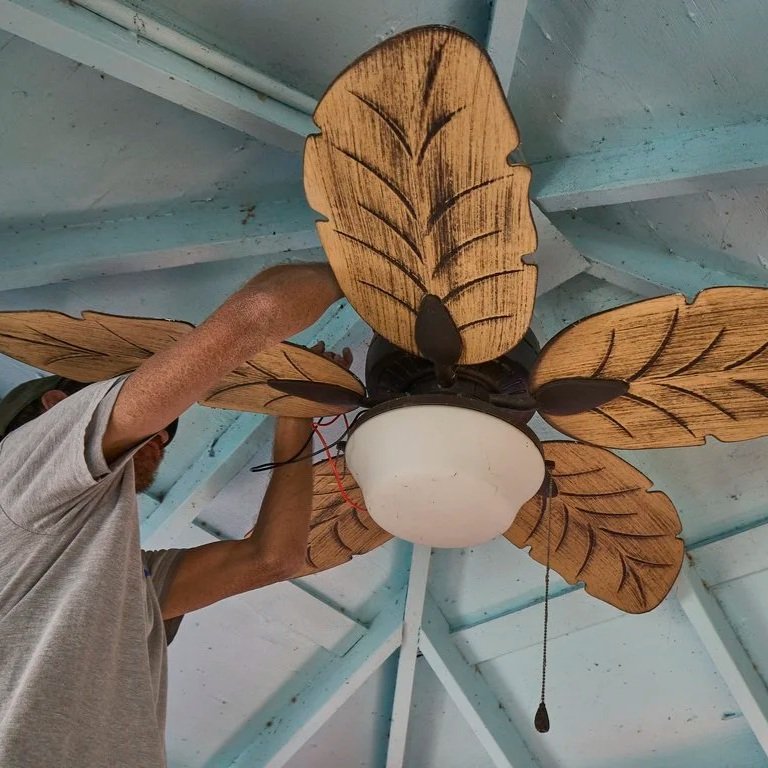
Electrician installing outdoor ceiling fan on covered patio designed to improve airflow, comfort, and humidity control in Florida homes.
Why Homeowners Keep Searching “Best Outdoor Ceiling Fan For Florida”
The best outdoor ceiling fan for Florida is not just a casual search. It usually follows frustration with a fan that rusts too quickly, wobbles in the wind, or barely moves air when the humidity is high. Many homeowners assume any ceiling fan labeled outdoor will perform well outside. In Florida’s climate, that assumption often leads to disappointment.
Florida porches and patios face a combination of heat, humidity, salt air in coastal areas, and frequent storms. Those conditions demand more from outdoor ceiling fans than mild climates ever would. Materials, motor housing, blade construction, and mounting style all matter more here. Choosing a fan solely based on appearance or price can lead to corrosion, motor failure, or weak airflow within a year or two.
Outdoor ceiling fans must do more than spin. They need to circulate enough air to make humidity feel manageable while resisting environmental wear. Understanding what makes a fan suitable for Florida conditions prevents wasted money and ongoing frustration.
Damp Rated vs Wet Rated And Why It Matters More Than You Think
One of the most misunderstood aspects of outdoor ceiling fans is the distinction between damp-rated and wet-rated fixtures. Homeowners often see both labels and assume they are interchangeable. They are not, especially in Florida.
Damp-rated fans are designed for covered outdoor areas where they are protected from direct rain. Think screened lanais, covered patios, or porches with solid roofs. These fans tolerate humidity and indirect moisture but are not built to handle water exposure from storms or wind-driven rain.
Wet-rated fans are constructed to withstand direct exposure to rain and moisture. They use sealed motors, weather-resistant finishes, and blade materials that resist warping. In Florida, where sudden downpours and sideways rain are common, installing a damp-rated fan in a partially exposed area often leads to early corrosion and electrical issues. Choosing the correct rating from the start protects the investment and avoids premature replacement.
The Common Mistake Of Choosing Style Over Airflow
Many homeowners focus first on how the fan looks. They want a sleek modern design or a coastal aesthetic that matches outdoor furniture. While appearance matters, airflow performance determines whether the fan actually improves comfort.
Outdoor spaces often require larger blade spans than indoor rooms. Open-air environments allow airflow to dissipate quickly. A small fan that works fine in a bedroom may feel ineffective on a patio. Homeowners frequently install undersized fans because they look proportionate to the ceiling, only to discover they cannot feel a noticeable breeze.
Blade pitch also influences performance. Steeper blade angles move more air but require stronger motors. Cheap fans with shallow blade pitch may spin quickly yet push very little air. Matching the blade span and pitch to the size of the porch or patio creates meaningful airflow rather than cosmetic motion.
Motor Quality And Why Florida Humidity Exposes Weakness Fast
Outdoor ceiling fans rely heavily on motor durability. In Florida, high humidity and heat stress electrical components year-round. Motors that are not sealed properly corrode internally, leading to noise, reduced speed, or failure.
Homeowners often notice grinding sounds or inconsistent speed after only a few seasons. They assume outdoor fans do not last long. In many cases, the problem traces back to lower-quality motors not designed for continuous exposure to moisture.
Investing in a fan with a sealed motor housing and corrosion-resistant components significantly extends lifespan. While upfront cost may be higher, the long-term reliability prevents repeated replacements and service calls.
Blade Materials And Warping In Humid Climates
Blade material matters more outdoors than indoors. Even treated wooden blades can warp in Florida’s humid environment. Warped blades cause imbalance, wobbling, and vibration that worsens over time.
Plastic composite or ABS blades handle humidity and temperature swings better. These materials resist warping and maintain balance even after years of exposure. Metal blades with protective coatings also perform well in certain designs.
Homeowners often underestimate how quickly humidity affects materials. A fan that looks stable during installation may begin wobbling after a single rainy season if the blade materials cannot withstand moisture. Choosing the right material prevents daily annoyance and structural strain on mounting hardware.
Sizing Outdoor Ceiling Fans For Porches And Patios
'What size outdoor ceiling fan do I need?' is another frequent question. Sizing depends on the covered area's square footage and ceiling height. Larger patios require blade spans over fifty-two inches to create meaningful airflow.
In Florida homes with expansive lanais or outdoor kitchens may require multiple fans. Placing fans strategically across seating areas distributes airflow evenly. Installing a single small fan in the center of a large patio often leaves the corners stagnant and humid.
Ceiling height also affects performance. Fans mounted too high fail to deliver noticeable airflow at seating level. Downrods adjust the fan to an optimal height, typically between eight and nine feet above the floor. Proper positioning maximizes airflow without creating turbulence.
Wind, Storms, And Secure Mounting
Florida weather includes sudden storms and strong winds. Outdoor ceiling fans must be securely mounted to fan-rated electrical boxes designed to handle movement and weight. Standard light fixture boxes are not sufficient.
Homeowners sometimes reuse existing boxes without verifying their rating. That shortcut leads to wobbling or loose mounting over time. Strong gusts combined with fan operation can cause stress on the mounting hardware.
Proper installation reduces vibration and extends fan life. Secure mounting also prevents cosmetic ceiling damage and protects wiring connections inside the junction box.
Energy Efficiency and Year-Round Use
Outdoor ceiling fans complement air conditioning by improving airflow near entryways and transitional spaces. In Florida, covered patios often connect directly to living areas. Improved airflow outside reduces the amount of warm air that drifts indoors when doors open.
Energy-efficient outdoor ceiling fans with DC motors use less electricity while delivering strong airflow. These motors operate quietly and adjust speed smoothly. Homeowners often notice reduced noise compared to traditional AC motor fans.
While outdoor fans do not lower the temperature, they improve comfort enough to reduce reliance on portable fans or lowering indoor thermostats excessively. Over time, consistent airflow contributes to more stable cooling patterns throughout the home.
Lighting Integration And Outdoor Use
Many outdoor ceiling fans include integrated lighting. In humid environments, selecting fixtures rated for outdoor use is critical. Moisture-resistant light kits prevent corrosion and electrical issues.
Homeowners sometimes install indoor light kits on outdoor fans to save money. That shortcut leads to condensation inside fixtures, flickering bulbs, or early failure. Using outdoor-rated components protects both the lighting and the fan motor.
Proper lighting also enhances safety on patios and porches. Balanced illumination combined with steady airflow creates inviting spaces rather than harsh or dimly lit areas.
When Professional Installation Makes A Difference
Kennedy Electric frequently installs outdoor ceiling fans for Florida homeowners who previously experienced early failures. Common issues include corroded wiring connections, improperly mounted boxes, and fans that were never rated for true outdoor exposure.
Professional installation addresses more than wiring. It evaluates ceiling structure, electrical load, weather exposure, and mounting stability. Correct installation prevents wobble, reduces noise, and extends lifespan.
Outdoor ceiling fans should make porches and patios usable year-round. When chosen and installed properly, they transform humid evenings into comfortable outdoor living time rather than forcing everyone back indoors.
FAQs
Wet-rated fans with sealed motors and moisture-resistant blades perform best in Florida’s humid and storm-prone climate.
Indoor fans are not designed for humidity and temperature swings. Even covered patios in Florida require damp or wet-rated fans.
Large patios often benefit from multiple fans spaced evenly across seating areas to distribute airflow effectively.
Outdoor fans improve comfort and airflow, reducing the need to set indoor thermostats too low.
Wobbling often results from warped blades, improper mounting, or corrosion affecting balance. Using weather-resistant materials and secure installation prevents these issues.
